Dr Frank Rushbrook CBE visited our labs today. That's the 'Rushbrook' Fire Laboratory, which he helped establish. While he was with us, I asked him to sign a copy of his book "Fire Aboard" (3rd Edition), which he gladly did.Friday, September 09, 2011
One good book deserves another
Dr Frank Rushbrook CBE visited our labs today. That's the 'Rushbrook' Fire Laboratory, which he helped establish. While he was with us, I asked him to sign a copy of his book "Fire Aboard" (3rd Edition), which he gladly did.Wednesday, September 07, 2011
Was it worth it?
It is then, the end of April, when two of my final year undergraduate students (Alex Duffy and Phil Close) approached me with what they called “a crazy but very exciting idea.” I have to say that I agreed to see them hoping that all they wanted was to have a nice chat. I had enjoyed more than one of those chats with both of them, these were all interesting and very enjoyable nevertheless way too lengthy (mostly my fault...I get carried away when students are willing to listen to me).
They showed up with drawings for “The Temple.” Alex and Phil had just got involved in supporting the fire aspects of the design of “The Temple” for “Burning Man.” They were seeking for technical support from me.
For those of you who know me and “Burning Man” you will immediately conclude that there is nothing more distant from my “life philosophy” than “Burning Man.” For those of you who know me but do not know of “Burning Man” I will suggest you Google it so that you can come to the conclusion that “Jose Torero” and “Burning Man” do not belong in the same sentence. For those of you who do not know me, just believe me, I do not engage with nature, I support repressing your feelings, I actively engage in suppressing any form of counter-culture and I am convinced that the generation of 1968 and the Hippies are the source of selfishness and greed that is the basis of the inevitable demise of the Western cultural model.
As Alex put it “this will be the biggest and most impressive Temple ever built,” it represents the “transient nature of life” and thus the way it burns has to “reflect the evolutionary nature of life.” The final statement: “It'll be intense, but it’s a once-in-a-lifetime experience!” On top of the magnitude and complexity of the task, the architectural design was already completed, the structural design was well advanced and the burn date was set to Sunday, September 4th. As you can imagine, given my commitments, my state of mind, the imminent deadline and the nature of the project this was the last thing I wanted to do.
Furthermore, undergraduates are the source of the greatest ideas but not necessarily have the experience or skills to develop them, thus the prospect of yet another unmanageable commitment was quite obvious from the onset.
I have to say that the only reason why I agreed to be involved was because I do not know how to say NO, especially to students. They are the one and only reason why I am in a University and they bring to me the energy that many times is the one thing that keeps me going. I feel I owe them, so I cannot say no. I took a deep breath and said fine...“but you have to do all the work! I can answer your questions, give you ideas but I am in no position to drive anything...” they obviously agreed, so we were ON, but... deep in my mind all I wanted to do was to run as far away as possible from this project.
As it happens, when you panic you enlist someone to help you, so I asked Luke (structural support) to come to the next meeting. I could have enlisted other people but I was truly ashamed of asking, I did not feel that I had the right to waste anyone else’s time in such insanity. Just to further overwhelm me, Luke took less than 10 seconds to fully empathise with Alex and Phil and before I could utter a word he was suggesting that the burning rates should be controlled in a manner such that the growth and decay of an individual’s life was reproduced by the rate of burning and the ultimate rate of collapse of the different components of the structure representing each stage of life. I am trying to paraphrase him, but his thoughts were so fluid and were expressed in such a natural way that I would never be able to repeat what he said! At that point I finally understood what I had got myself into...
The building design was consistent with the magnitude of the “metaphysical vision” – needless to say, seeing the first drawings was not comforting experience. First of all, it is massive (about 10 storeys high) and it is quite intricate. As can be seen from the sketch there is a main structure surrounded by 5 smaller structures all linked by cloisters and bridges. Each smaller structure represents a stage of life finally uniting in the central structure that somehow represents the union that is life itself...If you want to know more about this check Alex & Phil’s website (http://burningmen.weebly.com/index.html)...as you can imagine all this entered through one ear and left through the other so fast that it has left no trace, thus don’t believe anything I am writing, check their website, I am sure they have it right. The one thing that remained was the magnificent magnitude of the engineering challenge.
Alex and Phil were serious, it only took a couple of names from me and they did all the rest. They got money to buy cameras, they convinced the Principal of the University of Edinburgh to pay for Phil’s plane ticket (Thank you Prof. O’Shea! – At the end Phil unfortunately could not come – he was truly missed) and got started with true engineering work.We had a couple of meetings and exchanged several e-mails concluding that the only way of controlling fire growth was to open the cavities inside the walls in a strategic manner so that the fire propagation will be managed in a manner that could be insensitive to wind (another factor – the place where the event is held (Black Rock City – Nevada) is well known for sudden and violent sand storms that can happen without warning). We will play with the connections and controlled reduction of the cross section of some of the structural elements to control the rate of collapse – I know that anyone reading this that has worked with fire in timber structures is probably already including me within the pack of lunatics self-labelled “the burners” (this is burning man lingo for those attending “the burn”) – but, for your comfort, I was as sceptical of our capability to master uncertainty as you probably are – more so when Alex told me that the person in charge of fire safety was a self-trained man who called himself Dave-X!
Well, Phil and Alex took the idea and with the help of Michal (thanks Michal!) developed a series of tests where they demonstrated how you could control the spread rate by varying the size and location of the openings. Needless to say, this was just done with a single panel under our lab hood, very far from the reality of a 10 storey temple but truly instructive.
E-mails continue to come and go. We discussed the structural details, connections, ignition sources, etc. You can see from the pictures below that there was a lot of effort and detail nevertheless the nature of the building was truly a challenge.It was at this point (mid June) that I decided that I should attend the burning of the temple. I thought that although it will be very difficult to arrange all the logistics and “Me” being a part of the “Burning Man” was by every possible measure wrong, I was so impressed and motivated by Alex and Phil’s commitment that I decided I will give it a try. I wanted to be there with them to see the outcome of their effort.
So, to make a long story short, I had to cancel a meeting in Australia, had to change my plane ticket to come back from Australia through the USA, rearrange my arrival in Lausanne (where I was heading afterwards) and numerous other things that I will not bore you with. At each stage I was wrestling with subconscious forces that insisted that I should not go. The truth is that it did not make any sense.In my struggle and “self-inflicted” ignorance I confused the burning of “The Man” with the burning of “The Temple” thinking that both will happen on the Saturday (“The Man” burns on Saturday, “The Temple” on the Sunday). So when I got an e-mail from Alex that opened with the following line: “Firstly...the Temple burn is the Sunday night! I truly hope that doesn't conflict with the travel plans you've arranged!” I flipped. What an understatement! I not only had to rebook all tickets with the associated hassle and cost but once again rearrange my already messed up schedule.
My subconscious did not stop playing tricks on me. Next thing I forgot was to buy the ticket....panic e-mails came from Phil and Alex indicating that “Burning Man” was sold out for the first time in history. Replies from me followed saying that I will pay “almost” whatever it takes for a ticket. This resulted in Alex finally finding a ticket for me. I am £270 poorer but the photo below did bring happiness to me when it arrived. That ticket was my ticket and now I was going to “Burning Man” – for God sake what was I thinking!
So, I left Sydney on September 2nd and after almost 20 hours of flight, two connections, a day change and 7 hours time difference I arrived in Reno. Not good, Reno and its airport are a sad example of “Casino Culture” that I find deeply unappealing, especially when I do not know what time or day it is. Got my bag and got the keys for my car rental. Things got a bit better when I saw the upgrade Avis gave...the American version of the convertible roadster...a decapitated Chrysler! Nevertheless, given the blue skies and the thirty something degrees, the gesture brought back life to my body...thank you Avis!I decided to split the trip in two, I was afraid of falling asleep while driving and I did not want to get lost in the desert at night. So, I drove for an hour and crashed in a nondescript hotel next to Route 80. It was 7:45 pm when I arrived, I fell asleep at about 8:15 pm and was bright awake by 11:45 pm... the wonders of jet lag. A combination of reviewing a paper draft, some work on Fire Safety Journal and answering the 300 e-mails that had arrived while I was travelling brought me to 7:30 am when I went to the supermarket to buy supplies and a coffee. Supplies? Seriously... what do you bring to the desert? So I got olives, tortilla chips, baby bells and about 100 litres of water. The rules I used were, does not need to be kept cold and I do not need cutlery to eat it. In any case, it will not be the first time I survived 36 hours without eating. So with my supplies and a giant “Americano” I jumped on the headless Chrysler on my way to the “Burning Man.”
The road is quite remarkable. Is about 2 hours of amazing scenery and towns with strange names “Nixon,” “Empire,” etc. The highlight was Pyramid Lake. I could not avoid taking a picture from the convertible. Not very good, but makes the point of the scenery and the emptiness. Finally, I arrived and went straight to “will call,” where Alex said my ticket will be. The ticket was not there! All I had was a picture of Alex with my ticket! Despite the fact that everyone seemed to know Alex, he could not be found among the 60,000 people at the camp. So, believe it or not I resorted to Dave X, they paged him and he replied, “yes, let the Professor from Ireland in!” Isn’t it ironic?
What comes after is an experience that unfortunately I am not talented enough to describe with words. So please forgive me if I do not manage to convey the true magnitude of the place. Hopefully the photographs will do a better job. I will just point to a few landmark events.Courtesy of Alex, I happen to be staying at “Camp Armageddon.” A collection of interesting characters that included a Stanford high power graduate reconverted into an organic blueberry farmer in Chico (California), an ex Marine now running a non profit that helps people build houses out of bales of hay and Alex’s father. My years teaching at Universities have generated a natural dislike for student parents and true disdain for “reconversion,” the term “organic” and especially sentences that mix the words “renewable” with “non-profit.” Thus I was set for a true psychological challenge.
When I thought that things could not get worse, a camp across the street started blasting heavy metal music – it was indicated to me that they had been assigned the time slot from 13:00 – 14:00. Exactly at 2:00 pm the music stopped and was replaced by Alex singing Elvis tunes with a ukulele – despite my apprehensions for “The King” and the “ukulele” it was a welcome relief.
I was taken by the hosts to the dress-up room provided with a feather head piece that would have made my Inca ancestry envious and delivered to this post apocalyptic real life recreation of the world of Mad Max.
Alex brought us to “The Temple” which looked much more impressive than in any of the diagrams I had seen. It was not only massive but it was ornamented by deeply personal messages that people had written for them to burn in some form of a cathartic gesture. In the centre some sort of “Voodoo meets Buddha” rituals were being performed supported by the rhythm of African drums. I have to say, I am generally completely indifferent to these practises, nevertheless, my self-control was tested when 3 naked men tightly hugged as they screamed a consistent message. This act was a means to break free from the emasculation that society brings on the modern man. My attitude changed from total disdain to absolute bewilderment.
The work done on “The Temple” was remarkable. Alex had managed to bring most of the ideas he and Phil had discussed with me into practise. “The Temple” had just become the first real scale test of the impact of cavity compartmentation on the growth of a fire in a timber building. This is a subject of great controversy on which rests the fire safety of timber buildings.
The night changed the flavour of the camp, nudity was substituted by flamboyant feather boas and faux-fur outfits that could be the envy of any fashion victim. The sanctity of the nudity and the prayer was substituted by loud music, screaming and fireworks leading to the burning of “The Man.” The party had begun.A man approached me, claimed being an anthropologist and asked me what I thought about life after death. As you might suspect, my answer was not what he expected. If I would have been given some warning I would have probably given him an answer that hid the simplicity of my mind, but I had no time to reflect on my story. My candid answer rewarded me with a coin, black on the one side symbolizing death and white on the other side with a Hebrew inscription symbolizing the eternity of life. The coin was intended to be a reminder of how far I still need to travel to achieve enlightenment. Point well taken!
A further reward came as a statement: “Embrace Burning Man because you are witnessing the creation of a new social order.” By the end of that night I had concluded that “Burning Man” was a reproduction of the existing social order in a context where everyone could simply be a more radical version of themselves. The power of anonymity!
Unfortunately I was deeply unprepared. The boot of the car was full of suits and ties (highly inappropriate) and the only shirt I had was an old Berkeley T-shirt. It was pointed to me by many of the “brothers” that those were symbols of society imposed cast systems that were not welcomed at “Burning Man.” Fortunately, I did not get the message until it was too late, because otherwise I might have felt compelled to adopt the more appropriate attire that consisted of nothing. That would have probably been offensive to the rest of the “burners.” My unpreparedness was so extraordinary that I did not realize that given the 1000 m altitude the temperature drastically drops at night, so while the days are terribly hot, the nights are cold. The dress-up room provided me with some colourful fabrics that enabled me to circulate at night without being cold. Sleeping was a different story, after more than 48 hours without sleeping I finally retired to the car at 2:00 am. By 5:00 am, and after turning the car on for heating 10 times, I was up and out facing what was still a roaring party.Alex and I left at 7:30 am, after the morning yoga session, back to “The Temple.” It is important to highlight one of the most interesting yet artificial premises of this group. There are certain “good rules” that are continuously overemphasized. Respect is one of them, I did not ask to do yoga, and thus no pressure or offer was extended to me. My space was respected. Affection is another one, brothers and sisters will greet with extreme affection in a choreographed manner that made a simple hand shake feel like a crime. Garbage control was an omnipresent one, while smoking is respected, people collected the ashes and cigarette butts as if they were precious gems. It leaves you wondering where the ashes of the first “non-Burning Man” cigarette will end ... on the floor?
At “The Temple” the worshipers were politely being driven out of the safety perimeter so that the work could commence. We went through a final analysis to attempt circumventing some of the constraints imposed by different external variables. I met some of the crew including the resident pyrotechnics expert. This individual seemed to derive way too much enjoyment from his work. I have to say that I left a bit restless. The indiscriminate used of “mild explosives” and “accelerants” could overrule any natural burning features. I came back twice again that day and my concerns continue to increase. The amount of fuel that was being added (in the form of anything that will sustain a flame) was quite overwhelming. I guess a big fire had to be guaranteed and once again, technical knowledge and a “natural” fire were secondary. It reminded me so much of the Dalmarnock tests, where we were trusted only until the critical moment. When the primordial objective is to be attained, the gut feeling of the “shaman” is more trustworthy than the knowledge of the “wise man.”
Sunday night “The Temple” looked glorious, the dust lifted by a mild breeze gave it a truly extraordinary look. People gathered around the temple with a sombre attitude. This posed a striking contrast with the party atmosphere of the previous night. Having been almost entirely deprived of sleep for almost 100 hours, the quiet and sombre nature of that evening suit me well.
The fire was simultaneously started in all five satellite buildings. From the onset you could clearly identify a sequence of growth, with the spread rates decaying in an anti-clock wise manner. Very rapidly the central tower started to burn with the flames spreading upwards at a colossal speed. In a matter of seconds the entire central tower was engulfed in flames (my feeling was that the in-house pyromaniac had given it way too much juice). The fire was so intense that at 100 m (safety perimeter) the radiative heat was close to the threshold of pain. At some point I almost stood up and started walking backwards but given that I was in the front row, it would have probably not been a wise idea to encourage others to start moving away. With great difficulty I controlled myself and managed to wait until the fire started to decay. Massive firebrands were being lofted, but in the almost absence of wind, they were falling straight back to areas were the fire was smaller. The smaller temples burned in the correct sequence (although I thought it should have been clock wise) with the collapses happening in a sequential manner as originally planned.
Unfortunately I had to leave immediately after. Believe it or not I had not had enough! It took more than three hours to get out of the camp and another three hours to drive back to the same hotel where I stayed on Friday. The time of arrival was 4:30 am, the time of departure of the first of my three flights was 9:00 am. Wake up time was 6:00 am. It is Monday now and I am sitting in planes on my 20 hour trip back to Europe hoping that at some point I will compensate for the 130 hours of sleep deprivation.
How can I summarize all this... did “Burning Man” change my life? Most definitely not! Was “Burning man” a good technical experience? Most definitely yes! Both from the physical and sociological sides. I have seen what would probably be the biggest fire I will ever see, I have explored the role of cavities, I have seen the potential consequences of a timber building fire, I have revisited the roles of the technical expert and that of the artisan, confirming once again that one of the strongest determining factors in our field is that relationship – the “shaman” vs. “the fire safety expert,” “the fire fighter” vs. “the engineer.” The technical expert always looses! Until we understand that dynamic we will have a hard time making progress!
From a personal side, I have confirmed that I have deeply engrained prejudices. Rightfully so sometimes but completely unjustified other times. Every minute of my 36 hours in “Burning Man” showed me that it requires deep thinking to purposely confront social structures, boldness and posturing are only thin masks of shallow social subversion that weakly cover conformism. Thus my prejudices in that sector are just reinvigorated. In contrast I have to say that I truly enjoyed the company of Ben, Alex’s father, he emerged as a deeply intellectual individual that had mastered the art of engaging, observing, learning and teaching in a manner such that it all simply appears natural. He made me reflect on that stage of parenting that evolves from guiding a child to delivering an adult. Like him, many of the people I met were probably more than what I expected them to be. My prejudices were truly unfounded and I am very sorry for that.
One final, but most important lesson I learnt. When asked to be involved and I did not say no, I did not realize what I was doing. I was allowing myself to enjoy my work. I was engaging with work in a manner that was consistent with the reasons why I chose this profession, thus I was deriving pleasure out of work. The big lesson... this is what I am supposed to do!
It is the students with their energy, their free spirit and their imagination that allow us to engage in remarkable activities. It has made me reflect back on the highlights of my career, that it was not me but Maria who encouraged me to save a derelict museum, it was actually Adam who first suggested that I should convince the BBC to film a documentary while we burned a skyscraper, it was Sam and Johan who instigated exploding an oxygen enriched building at 5000 metres above sea level and it was Alex and Phil who told me I should be involved in “Burning Man,” I am most grateful to all of these former students, but in this occasion especially to both of you, Thank you!
Alex promised me in his last message (before I arrived): “I'm confident you'll love it out here :)” and I did. Would I ever come back to “Burning Man” maybe ... but for different reasons, with a different objective and definitely more aware of what I am doing.
Was it worth it? ... Totally worth it!


Tuesday, September 06, 2011
Before the BP Blowout
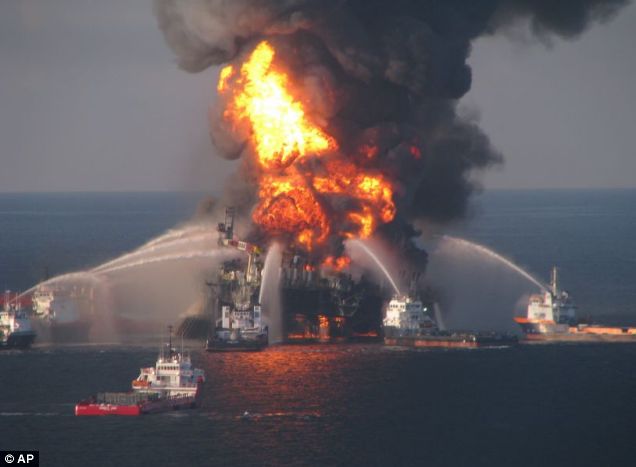
The rig operators spent 10 weeks trying to plug the leak before the escaping hydrocarbons caught fire on 2nd November 2009. No one was killed; a report published following an investigation of the incident explains why:
“No-one was injured or killed as a result of this incident. It has to be said that this is more good luck than good management and that, if the blowout had ignited immediately, the result could have been similar to the Deepwater Horizon incident which resulted in 11 fatalities and many injuries.”
Hayes, 2011.
Not exactly reassuring. The report went on to highlight a string of procedural failures that led to the eventual fire. One such failure concerned the Pressure Containing Corrosion Caps (PCCCs), which are used during the drilling process to plug the hole and prevent the oil flowing back up the drilling pipe. Even thought the design of the well included two such caps, only one was actually installed (despite the manufacturer's warnings that this would be insufficient).
Furthermore, during drilling the rig workers pump a slurry known as ‘mud’ into the well to lubricate the drill and balance the hydrostatic pressure of the rock formation (the pressure from the mud being pumped down must be greater than the pressure of the formation or there will be flow back up the pipe, causing a blowout). But perplexingly, the pressure difference was not monitored by the rig workers. The report states that:“In the case of Montara, it seems to have been assumed by everyone involved that the well was overbalanced but this was not the case.”
It would appear that various stages of mismanagement, cut-corners and poor practice eventually led to the blowout and subsequent fire on the Montara oil rig. A true example of ‘design-by-disaster’, this investigation will be used to upgrade rules and procedures and instigate necessary changes in legislation - a move that may well increase safety in the Australian oil industry.
But I fear this will not solve the problem. After all, oil companies in Australia and elsewhere are already subject to strict safety regulations and must conform to local procedures before, during and after drilling. So it would appear that lack of legislation and regulation is not the problem.
Perhaps it is the fault of the tools and systems used by the drilling contractor? This is also unlikely, as modern drilling systems contain multiple redundancies that, if used correctly, should prevent any blowout from occurring.
Just 5 months later the Deepwater Horizon suffered a similar blowout, and although the circumstances were very different, the root cause appeared to be the same: Human error. It seems that both the Montara disaster and the Deepwater Horizon could have been prevented if rules had been followed and/or people had understood what they were doing.
So if the regulations and technical systems are indeed up to standard, oil companies seeking to improve safety should seek to reduce human error. One option is to create and enforce new rules (and remove responsibility from employees) or educate employees to understand the risks and subsequent need for safety procedures.
![]() |
| The $250M Montara rig, after the fire |
If oil companies choose to create and enforce new rules they must focus on training. Employees must be taught to conform to the new rules and learn that rule breakers will be punished with disciplinary action. There are two major issues with this approach:
1 - Employees do not need to understand why the rule is there, just that they must obey it. To break the rule is to risk being punished; the implied risk to personal safety is not necessarily understood.
2 - If employees encounter a real situation for which they have not been specifically trained, they will be unable to react. If the rules are followed this should never happen; if the rules are followed.
Alternatively a company could educate employees to understand the risks and the resulting safety procedures. This could be done first by establishing a purpose - a desirable outcome - in this case: to prevent a blowout. Initially, rig workers could be encouraged to identify ways in which a blowout could occur, familiarise themselves with the problem and offer preventative measures (including ones they construct themselves). Only after employees have established the problem and attempted to solve it using their own methods should the company train them in additional, standard procedures and tools that have been shown to achieve the same result. In this way, employees learn to use safe methods and understand the underlying reasoning.
The Montara and Deepwater Horizon blowouts demonstrate that, even with extensive safety regulations and procedures in place, the responsibility for ensuring safety still lies with the individuals involved. If safety is to be improved proactively, rather than design-by-disaster, and if the industry is to contain responsible individuals who respect safety procedures then there needs to be a system of education that promotes understanding, not just compliance.
I wonder how many more catastrophes it will take for industry to realise this.
Monday, September 05, 2011
FIRESEAT: The science of suppression
Join us in Edinburgh on 9th November this year for a one day symposium on 'The Science of Suppression'. Online registration now open. Click the image above or visit www.fireseat.org for more information.
Saturday, September 03, 2011
Behind the scenes at the end-of-festival fireworks
This year, like many before, the fireworks are designed by Keith Webb from Pyrovision and he was kind enough to show us a bit of what goes on. The first thing that becomes apparent is the sheer scale of the display. There were fireworks everywhere!
| Fireworks. |
| More fireworks. |
| Even more Fireworks |
| Some of the fireworks are mounted to create directional displays. |
And this is only half - it is replicated on the other side of the castle!
We heard about how the display is planned to fit in with the music and how the use of computer firing means they can incorporate fancier sequences in the display. Surprisingly (at least for me), most of the firing is still done manually to make sure it is in time with the live music. This is what a firing board looks like:
| Firing board. It has a lot of buttons. |
It's a high-tech operation deserving of its own control room. This is where they plan, rehearse and manage the operation/tangle of wires.
| Control room with maps of the castle, the sequence of the display. |
| Two fire extinguishers ought to be enough. |
Unfortunately, time was limited and I have a few more questions that I would like to have asked Keith.
- How do you get the cross/heart shaped fireworks?
- What is the biggest firework in the show?
- How do you time the actual firework explosion to the music?
The fireworks display is this Sunday evening at 9pm.
Monday, August 29, 2011
A short history of the Dalmarnock building
In 2006, the BRE Centre for Fire Safety Engineering were involved in a series of large fire tests in a tower block in the Dalmarnock area of Glasgow. For details click here.
Did you know…?
A short history of the Dalmarnock building block before and after the Fire Tests.
The area of Dalmarnock was once heavily industrialised1. Sir William Arrol & Co. had its extensive engineering works there from 1873. From its beginnings in boiler making, the firm later became renowned for its achievements in the field of Structural engineering. Amongst the many bridges constructed throughout Britain by this firm, were the Forth Railway Bridge and Forth Road Bridge, the Humber Bridge and London's Tower Bridge. The company was eventually taken over by Clarke Chapman in 1969 and the Dalmarnock Works closed in 1986.
During the Second World War, the east side of Summerfield Street was bombed. Consequently, as part of the GEAR (Glasgow East Area Renewal) which took place during the '60s and '70s, most of the Victorian red-sandstone tenements from the neighbouring area were demolished, some were renovated, and a new housing scheme was built. The latter consisted of four 23 storey tower blocks and ‘H-block’ maisonettes.
The quartet of 23 storey tower blocks on the Millerfield estate in the south eastern corner of Dalmarnock, Glasgow, was formed by: 42, 403 and 504 Millerfield Road together with 1315 Allan Street. Approved in Phase 1 of the Summerfield project in 1962, construction was carried out by Laidlaw using the Prometo method. The design was by local architects, Parry & Hughes. The buildings were completed in 1964 and contained 132 flats each. Although initially popular with residents for being a vast improvement on the slums that predated post war development, lack of investment and maintenance made the block unpopular and the building housed fewer and fewer tenants.
In a massive regeneration effort to turn Dalmarnock into a potential Commonwealth 2014 Games village, the 4 tower blocks together with twelve maisonettes were demolished in different phases. On Sunday the 3rd of February 2002 at 11 AM, both 40 and 50 Millerfield Road blocks were demolished. They were the first high-rise demolition since a woman was tragically killed in 1993 as she watched the ill-planned implosion of Queen Elizabeth Square. The operation cost Glasgow City Council £1.2m to hire Yorkshire-based Controlled Demolition Group Ltd. Despite doing their best to keep the blow down secret, a small crowd had gathered to watch, but this time none of them were injured.
In January 2005, the decision was made by the Glasgow Housing Association to demolish 131 Allan Street. This came after the two other blocks in the scheme had been demolished 3 years before. All residents were rehoused by August 2006, with East End Community Homes doing their best to accommodate them all within the Dalmarnock/Bridgeton area, although the building was well below capacity. After almost a year preparation, the tower block was blown down in just 5 seconds by Safedem of Dundee and John F. Hunt using 85kg of explosives on the 5th of July 2005.
4 Millerfield Place was the one used for the Dalmarnock Fire Tests5 and the last to be demolished. Complications with preparing the building for demolition prevented it from being imploded in late-February 2007 as planned. There’s a version saying that “this was possibly as a result of an experiment into high rise fires conducted by the University of Edinburgh in 2006 affecting the structure's stability”. At 11 AM on the 9th of September 2007, this last block was finally demolished, leaving the entire Millerfield estate empty and awaiting new development which is ongoing by now.
The following is an interesting comment from a former tenant of one of these flats6: “I was there when the third multi-story was demolished, same as I was there when the first two came down, it was so sad for all of our families who have moved out of the area and the ones who still live in Dalmarnock as most of them spent their childhood days going to Springfield School in Allen St, if they didn't live in the flats they had friends and family who did. Dalmarnock was always a great place to live, I raised my family in the 70/80s. What a community we were in those days, I am always proud to say my son's came from Sunnybank St. Dalmarnock, getting back to the high flats, I remember in the winter months taking my lads to primary school in Allen St and taking the shortcut through the Millerfield flats, the wind was so strong it would blow us off our feet. I know Dalmarnock is going to be a brilliant place for the Commonwealth village, fingers crossed, let all the athletes come here and see what friendship is all about.”
So as we can see after this short story, there’s a curious succession of events specifically related to the high-rise used for the tests: the area was originally part of a structural engineering firm – notably the one that built both Forth Bridges – then came the very well known Dalmarnock Fire Tests, and finally ending its days being demolished on a 9/11. Recapitulating: structural engineering + Forth Bridge (there’s a photo of the beautiful railway bridge decorating Prof. Torero’s office) + fire tests + 9/11… strange coincidence...? J
By Agustin Majdalani
Demolition videos (131 Allan Street and 4 Millerfield Place):
http://www.youtube.com/watch?NR=1&v=-HzNwoWwEfQ
http://www.youtube.com/watch?v=jeObBJjB8Xs&feature=related
http://www.youtube.com/watch?v=-HzNwoWwEfQ&feature=related
http://www.youtube.com/watch?v=BteoagqYYFI
http://www.youtube.com/watch?v=VunUSR5znd8
http://www.youtube.com/watch?v=jB4g5rZtL4c&feature=related
Demolition photos:
http://www.gha.org.uk/content/mediaassets/Millerfieldgallery/millerfield/index.htm
Friday, August 26, 2011
Holly Smith receives JM Lessells Travel Scholarships from Royal Society of Edinburgh
Holly will spend two months at the Department of Civil Engineering, Queen’s University, Kingston, Canada. She will be examining methods of using digital image correlation in support of her PhD work on shear failure of concrete structures during fire, which is supervised by Dr Tim Stratford. This technique has only recently been applied in structural engineering by Dr Andy Take of Queen’s University and as a consequence there are a number of challenges in its use. Her visit to Queen’s University will allow her to gain expertise from Dr Andy Take and Dr Neil Hoult, who have been extending Take’s digital image analysis methods to structural measurements and work on a post-processing technique to interpret the initial results that she has obtained from her first set of experiments. Queen’s University also has concrete structures in fire research activity, led by Dr Mark Green, and working with this group will also be very beneficial for Holly’s research.
Tuesday, August 16, 2011
The Endemic of the Academics
As a newcomer to the fire science scene (and a new member of IAFSS) I was disappointed and downhearted by the recent 2011 IAFSS symposium in
The conference started on the Sunday with a student networking event and workshops session. Both of these I missed due to a delayed flight but if these workshops were similar to the one I attended on the following Friday morning they would have been useful and added value to the conference. This cannot be said for the reaction to the student session that I have enquired about. The student session was apparently organised as a networking opportunity for the students. There was no formal structure to the session and students were left to their own devises and allowed to mingle. This lead to the anticipated reaction of the students interacting only with the people they knew, and therefore there was little networking.
In my opinion, while the students clearly play a role in a successful networking event, a better scenario for a student session is not to network solely with other students but rather with the academics and industry professionals who are present at the conference so that enthusiasm for the sector and for scientific research could be instilled. This could have been achieved by having a student workshop where a few of the well-regarded academic/industry individuals could pose a few issues and then workshop it with the students. This would promote interaction and discussion on fire science but would also allow for people to participate as much or as little as they feel able. A session like this would add value to any conference.
The rest of Sunday was good: the welcome team were very welcoming and registration was accomplished with speed and ease. The symposium welcome reception that evening, being the first official event that I attended, was well attended and had a buzz of excitement and anticipation, as there should be at the start of any major conference, and which I easily got swept up in; this buzz, however, was emphatically swept away by the symposium’s opening keynote.
The opening keynote was, in my opinion, disjointed and virtually impossible to follow. To open a Fire Safety Science symposium by showing a six minute video of a tsunami decimating a town seems inappropriate, unless the keynote was on the dangers of tsunamis for fire safety, which it was in part and was also on risk based design. While I agree that it is good and right to honour those academics and researchers who have contributed to the field, I feel that this should not be done to the detriment of the Association or its symposia. Neither topic was covered properly, nor did either pose clear and important questions to lead to a lively and informative debate.
The opening plenary was not the only one to disappoint, but there were, in my opinion, two strong keynotes worthy of mention. The first of these was by Margaret Simonson McNamee, of SP, with her presentation on “Estimating the Impact of Fire on the Environment”. This presentation raised issues not only relevant to fire safety science but also to a major driver for many endeavours in today’s world, the environment. This issue was apparently lost on the symposium caterers, as an appalling amount of waste was produced during the symposium in terms of plastic plates, cutlery and mugs. Future symposia should demand better environmental controls from the conference venue and catering services.
The second interesting plenary was Charles Fleischmann’s keynote “Is Prescription the Future of Performance Based Design?” This lecture, although with an (intentionally?) oxymoronic title, stimulated debate, especially amongst the structural fire engineers, and generated a genuine scientific and philosophical talking point at meal times. This is one highly desirable outcome of a good plenary or keynote lecture.
Disappointing talks were not limited to keynotes. Many of the presentations did not specify the relevance of the work undertaken and had no obvious conclusions; simply summarising what had already been discussed. In several presentations the use of videos detracted from the information being presented (and in one case the presenter was silent for 2 and a half minutes because of a video). It seemed that some research was undertaken just for the sake of doing some research and the value of it was not clearly communicated to the audience.
I feel that there were also problems with the rigour of work presented, and in the research methods used, particularly in the area of evacuation modelling and analysis, which felt marginal in some cases (although I stress here that I am by no means an expert in this area). The poor-quality feel of work presented at the conference is clearly not solely the fault of the authors and presenters, but also of the scientific committee. The fact that about 50% of the papers submitted were accepted, according to the President’s presentation during the “business” meeting, seemed to be driven largely by the finances of the conference rather than the quality of the work. While this is speculation on my part, I feel that a peer reviewed conference should strive, first and foremost, to increase the quality of the work, however in this case the finances of the conference may have nullified this scientific quality control measure. I am all in favour of peer reviewed conferences; this promotes excellence. But the ambition of running three parallel sessions seems to have muddied the waters and diluted quality. I understand that sufficient funds are needed to cover certain costs, but as a charitable organisation the IAFSS must ask if the costs (and profits) of conferences should be rationalized so that financial drivers do not detract from the scientific quality of the symposia.
The above being said, the parallel sessions were run effectively and efficiently, along with the poster sessions, and so congratulations are due to the chairs of the sessions and the organising committee. There was, however, an issue with the final day of the symposium. The first four days all started at 9.00am with a keynote lecture. The last day, on the morning after the conference banquet, had only 9 talks scheduled. Unfortunately, these started at 8.30am, so it was no surprise that at 8.30am in the morning in the session in which I was presenting (which I am admittedly, slightly bitter about) there were two chairs (one of whom was drafted in last minute), the three presenters and only one other audience member. This scheduling was unfair to those who were asked to present or chair these final sessions. Future symposia should take this into account.
After I left the 2011 IAFSS Symposium, I was left wondering whether it had met the objectives of the association, as presented in the rules of the association given to every member:
“The object of the Association is to promote research into the science of preventing and mitigating the adverse effects of fires and the dissemination of the results of such research. In furtherance of this object the association will organise and support symposia and other educational activities in the field of fire safety science, publish the proceedings of such symposia (provided it shall not undertake any permanent trading activities), seek to co-operate with other organisations concerned with the application of fire safety science and do all such other lawful things as may further the objects of the Association”.
The IAFSS does focus on issues of fire safety science on the international scene, but it is the association aspect of this community that I feel is struggling somewhat. The definition of association, according to Dictionary.com is:
1. an organization of people with a common purpose and having a formal structure.
2. the act of associating or state of being associated.
3. friendship; companionship
On the first two aspects of the word, the conference delivered to some extent, and on the third aspect the working friendships and associations were well represented, but are these professional friendships actually helping or hurting the association – is the association too close? It seemed to me that we accepted the presenters’ statements and ideas, rather than being convinced by them, we did not question enough what people were saying or why they were saying it, and we did not discuss or debate enough the further implications of the work presented. Are we scared of losing our status and no longer being pioneers in the field, let alone the wider world? Do we strive to be noticed and liked rather than producing excellence in our work which might ruffle a few feathers? Are our associations with one another too polite and self-edifying? Do we need to rethink what the association is about, or are we happy with the way things stand?
By David Rush
Tuesday, August 09, 2011
Defining the Future of Fire Safety Engineering Education
The 2011 LRET/UoE Global Technical Leadership Seminar in Fire Safety Engineering
Last year, BRE Centre for Fire Safety Engineering at the University of Edinburgh secured a major grant from The Lloyd's Register Educational Trust (LRET), to hold a series of three annual week-long intensive seminars ("think tanks") in areas related to Fire Safety Engineering.
This series of seminars was motivated by the need to have a new generation of leaders in Fire Safety Engineering that can drive the field through the drastic transition it is currently experiencing. An ever evolving construction industry, drastic changes in regulatory environment, multi-disciplinary drivers for innovation, and ever increasing demands for the fire service require a new face of leadership. The seminars are intended to bring together selected leaders of today with the leaders of the future to define a coherent path for different areas of critical importance to the field.
The globally unique initiative was launched this year with The 1st Annual LRET/UoE Global Technical Leadership Seminar in Fire Safety Engineering. The seminar had the theme of "Education for the Future of Fire Safety Engineering," and was held in Scotland between 30 May and 3 June 2011. Participants were selected as key players in defining the future of advanced fire safety engineering as a professional/academic discipline.
The seminar was run as a five day retreat, delivered by the BRE Centre for Fire Safety Engineering at a residential venue close to Edinburgh. Each session began with a presentation to be given by one of the participants (see below). This initiated discussions on the relevant issues. A small group of undergraduate and graduate students, some of whose stuudies are also financially supported by The LRET, were also competitively selected to join the seminar, bringing the total number of participants to approximately 20.
The University of Edinburgh further funded a dedicated PhD student (Michael Woodrow) to support the seminar. Along with Edinburgh staff and the seminar participants, Michael will compile the outcomes of the seminar and disseminate these (with the approval of the participants) to the relevant stakeholders. Dissemination activities will include the publication of a "white paper" based on the seminar's discussions and outcomes.
All of the participants felt that the event was a great success and will lead to a number of important changes, actions, and significant progress for fire safety engineering education globally. Feedback icipants has been very positive thus far, and several participants have formulated specific personal action items within their own organizations.
Participants pose for a group photo outside the Seminar venue, Archerfield House Estate, near Gullane, Scotland. From left to right: Sarah Higginson, Michael Franklin, Ieuan Rickard, Eduardo Maciel, Michael Woodrow, David Crowder, Bjorn Karlsson, Jose Torero, Luke Bisby, Peter Johnson, David Mallin, Kathleen Almand, Chris Lawless, Thouria Istephan, Peter Sunderland, Angus Law, Agustin Majdalani, Paul Jenkins, Cristian Maluk (not shown: Neal Butterworth, Maria Garlock)
PROGRAMME AND PARTICIPANTS
The venue for the 2011 seminar was Archerfield House Estate, in Gullane, Scotland. The participants are listed in the table below, in alphabetical order:
The programme for the seminar was built around presentations on issues around fire safety, delivered by selected seminar participants. A list of the presentations is provided below:
“Why The LRET Funded this Programme”
Michael Franklin (Director, The LRET)
“The State of Fire Safety Education”
Jose L. Torero (Director, BRE Centre for Fire Safety Engineering)
“The Current Needs of Industry/Consultancy”
Peter Johnson (Arup Fire, Australia)
“The Current Needs of Architects”
Thouria Istephan (Foster + Partners, UK)
“The Swedish Model - How Sweden Implemented Change”
Bjorn Karlsson (Director, Iceland Construction Authority)
“Societal Barriers to Technological Knowledge Transfer”
Chris Lawless (Institute for the Study of Science, Technology and Innovation, University of Edinburgh)
“The Evolution of Codes and Standards”
Kathleen Almand (Director, Fire Protection Research Foundation, USA)
“Introduction to the Scottish Fire Services College and Firefighter Training in Scotland”
Gary Stewart (Programme Manager – Practical Skills, Scottish Fire Services College)
“How do we train people in the fire service today?”
David Mallin (Lothian and Borders Fire Brigade)
“Tomorrow's Needs of the Fire Service given Current Evolution in Building Design and Regulatory Processes (Knowledge, Training, and Changes in Practice)”
Paul Jenkins (London Fire Brigade)
“Structural Engineering/Architecture/Fire Safety –How are People Educated at Princeton?”
Maria Garlock (Princeton University)
“Fire Protection Engineering Education in the USA”
Peter Sunderland (University of Maryland)
“Learning Lessons from Fire Incidents”
David Crowder (BRE Fire & Security)
“Proposals for the Way Forward”
The LRET Scholars (University of Edinburgh students)
“Conclusions and Discussions on White Paper”
Michael Woodrow (PhD Candidate, University of Edinburgh) and Luke Bisby (Reader, University of Edinburgh)
HANDS-ON EXPERIENCE
Seminar participants were exposed to one full day of training and presentations at the Scottish Fire Services College, in Gullane, Scotland. Activities included introductory breathing apparatus training, hands-on flashover and flame cooling training, and a smoke movement demonstration and training exercise. This unique, practical experience was the first time that most of the participants had participated in such activities, despite most being global leaders within the fire safety community, and was a real eye-opener for everyone involved. On the back of this collaboration between the BRE Centre and the Scottish Fire Services College, discussions are underway to launch additional collaborative and joint training programmes. The most recent issue of the Scottish Fire Services College Newsletter highlights this (see link).
Seminar participants get first-hand experience at tackling real fires in buildings (training activities and photograph graciously provided by Gary Stewart of the Scottish Fire Services Training College, Gullane, Scotland)
INITIAL OUTCOMES
The discussion and ideas generated during the Seminar are being distilled and summarized in a “white paper” on fire safety engineering education. This work is being led by PhD student Michael Woodrow, in collaboration with Dr Bisby and Prof Torero, and it is expected that this will lead to the publication of an archival journal paper. Once published, this work will be circulated widely both within and outwith the fire safety engineering community. It is expected that this will catalyze further discussion on the important issue of education within the broader fire safety community.
Feedback from the applicants has been uniformly positive (see below), and in general there is a clear consensus that the Seminar provided a unique and productive opportunity to think deeply about the significant issues facing the Fire Safety Engineering discipline generally, and about the education of Fire Safety Engineers specifically.
Spontaneous correspondence and communication has occurred between several of the Seminar participants, and independent dialogue is now occurring around the issue of fire safety engineering education. The intangible benefits and possible outcomes of such ongoing communications are difficult to quantify but can only cause positive change within the fire safety community.
The International Association of Fire Safety Sciences has recently reinvigorated its Education Committee under the part leadership of 2011 Seminar participant Prof Björn Karlsson, and it is expected that the seminar outcomes will influence the actions of this committee.
PARTICIPANT FEEDBACK
“I want to say how stimulating the week at Archerfield was to me, and how beneficial it will be to the entire community of Fire Safety Engineering. It is a rare pleasure to have people from such diverse professions come together for a common cause. I learned more than I ever could have imagined. Thanks for including me in this week of stimulating discussions. I have never experienced anything like this before. It was a great experience for me and everyone there. Our entire field will be the beneficiary.”
- Dr Peter Sunderland, University of Maryland
“It was a fantastic week. Very valuable time. I think we are all very grateful to Michael (Franklin) and The LRET for the opportunity. And of course we all loved the fire training, for which we are most grateful to David (Mallin)... I think we all started to learn about the real challenges of fire fighting. Many thanks to you Luke, Jose, and all from the University of Edinburgh for all the organization. An excellent time.”
- Peter Johnson, Arup
“I want to thank you for everything you did during and before this week, I am so glad that you included me in this event. I had a great time, and I had the chance to meet great people. I want to do something in Mexico about (creating) fire engineering courses after I spend a few years learning and getting more experience in Europe, but I think this week helped me to have an idea at least on where to start and where to look for information.”
- Jorge Eduardo Maciel Franco, LRET MSc Scholar
“Thanks again so much for the opportunity to be a part of this workshop. I found it very valuable!”
- Maria Garlock, Princeton University
“Very thought provoking, the process turned my ideas on education around quite a few times and I feel more informed on the subject as a result. The company was wonderful and the surroundings too.”
- Prof Björn Karlsson, Iceland Construction Authority
THANKS
The BRE Centre for Fire Safety Engineering would like to extend our deepest thanks and appreciation to The Lloyd’s Register Educational Trust for making this unique event possible, and to its Director, Mr Michael Franklin, for his enthusiastic and active participation in the week’s activities and discussions; it is indeed rare to find a patron with such a demonstrated interest in The BRE Centre’s work.
Many thanks to all those who attended!!
Planning is already underway for the 2012 LRET/UoE Global Technical Leadership Seminar... more information will follow... stay tuned...