Fire Banner
Showing posts with label paper. Show all posts

Tuesday, July 08, 2014

SiF 2014 conference - Shanghai: Paper and Posters

A strong Edinburgh delegation presented several papers at the 8th International Conference on Structures in Fire, held in Shanghai in June 2014.  The titles and authors of the papers are listed below (Edinburgh authors highlighted in bold), and the proceedings of the conference can be found at http://www.structuresinfire.com/

Title: Towards fragility analysis for structural fire resistance: residual capacity of concrete columns
Authors: D. Rush, L. Bisby, I. Ioannou and T. Rossetto
Proceeding pages: 459 - 466

Title: Deformation and response of continuous and restrained post-tensioned concrete slabs at high temperatures
Authors: J. Gales and L. Bisby
Proceeding pages: 305 - 312

Title: Software firelab for probabilistic analysis of steel-framed structures in fire
Authors: S. Devaney, A. Usmani and C.S. Manohar
Proceeding pages: 919 - 926

Title: Selection criteria of fire scenarios for buildings
Authors: I.Del Prete, G. Cefarelli, A. Ferraro, E. Nigro and D. Sannino
Proceeding pages: 1079 - 1086

Title: Punching shear of restrained reinforced concrete slabs under fire conditions
Authors: H.K.M. Smith, T. J. Stratford and L. Bisby
Proceeding pages: 443 - 450

Title: Evaluating design guidance for intumescent fire protection of concrete filled structural hollow sections
Authors: D. Rush, L. Bisby and A. Jowsey
Proceeding pages: 1071 - 1078

Title: High temperature performance of sustainable concrete with recycled concrete aggregates
Authors: J. Gales, T. Parker, M.F. Green, D. Cree and L. Bisby
Proceeding pages: 1203 - 1210

Title: Mechanical properties of fibre reinforced polymer reinforcement for concrete at high temperature
Authors: E. McIntyre, A. Bilotta, L. Bisby and E. Nigro
Proceeding pages: 1227 - 1234

Title: Experimental and numerical studies on damage mechanisms in cementitious coatings on structural steel members
Authors: S.W. Chen, L.M. Jiang, A. Usmani and G.Q. Li
Proceeding pages: 1251 - 1258

Title: Analytical solutions for nonlinear response of plates under thermal loading
Authors: P. Khazaeinejad and A. Usmani
Proceeding pages: 969 - 978

Title: Post-fire residual capacity of protected and unprotected concrete filled steel hollow columns
Authors: D. Rush, L. Bisby and A. Jowsey
Proceeding pages: 435 - 442

Title: Influence of ductility on the behaviour of RC frames in post-earthquake fire 
Authors: Asif H. Shah, Praveen Kamath, Umesh K. Sharma, Pradeep Bhargava, Asif Usmani, GR Reddy, Tarvinder Singh and Hitesh Lakhani
Proceeding pages: 279 - 286


Title: Calibration of a simplified method for fire resistance assessment of partially encased composite beams
Authors: E. Nigro, I.D. Prete, D. Sannino and G. Cefarelli
Proceeding pages: 713 - 720

Title: Fire-induced progressive collapse of braced steel structures
Authors: J. Jiang, G.Q. Li and A. Usmani
Proceeding pages: 887 - 894

Title: An opensees-based integrated tool for modelling structures in realistic design fires
Authors: L.M. Jiang, Y.Q. Jiang, J. Jiang, A. Usmani and S.W. Chen
Proceeding pages: 987 - 994

Title: A novel test method for the study of structures in fire (topic: experimental studies)
Authors: C. Maluk and L. Bisby
Proceeding pages: 1063 - 1070

Title: Fire safety check of existing tall office buildings applying fire engineering approach: a case study
Authors: E. Nigro, I. D.Prete, G. Cefarelli, Anna Ferraro, Domenico Sannino and Gaetano Manfredi
Proceeding pages: 1087 - 1094

Monday, November 28, 2011

2011 Lloyd’s Prize to fire research

Congratulations to Dr Angus Law and co-authors for winning the 2011 Lloyd’s Science of Risk Prize in the Biological/Technological category for their paper on travelling fires for structural design. Dr Law graduated in 2010 with a PhD in Fire Safety Engineering from the University of Edinburgh and now works at Arup. The Science of Risk Prize was launched by Lloyd’s to stimulate cutting edge research into the latest emerging risks facing businesses.


 Design for infrastructure protection

The winning paper  is "The Influence of Travelling Fires on a Concrete Frame" (published in Engineering Structures 33), led by Dr Law and co-authored by Dr Stern-Gottfried, Dr Gillie and Dr Rein. The work argues that the trend towards open plan offices has changed the types of fire likely to occur in modern buildings. It uses science to look at ways to improve engineering guidelines and building design, reduce the risk of travelling fires, and help insurers better quantify and model fire risk. The presentation given by Dr Law at the award's ceremony built on the concepts of acceptable risk and the margin of error of design methods in the contextt of the engineering duty to use the world’s limited resources as efficiently as possible (see presentation here). The work was founded by BRE Trust and Arup.

Best runner-up

The best runner-up in the same category was our graduate Dr Sung-han Koo for his paper "Sensor-steered fire simulation" (published in Fire Safety Journal and co-authored by Dr J Fraser-Mitchell and Dr S Welch)

2010 Awards

This is the second time that Edinburgh recieves the award. Last year Dr Francesco Colella won the 2010 (inaugural) prize in Technology for the paper "A Novel Multiscale Methodology for Simulating Tunnel Ventilation Flows During Fires". And Dr Wolfram Jahn (in Technology) and Dr Claire Belcher (in Natural Hazards) were short-listed within the top five submissions.

Related links:

Monday, December 20, 2010

Fertilizer fire aboard cargo ship

A recent journal paper titled "Small-scale experiments of self-sustaining decomposition of NPK fertilizer and application to the events aboard the Ostedijk in 2007" has published in Journal of Hazardous Materials. Its content is presented here.


The global fertilizer industry produces 170 million tonnes of fertilizer annually. As the global population increases and countries develop, this is expected to rise. Production sites are limited to locations with good availability of key raw materials. Therefore, large quantities are required to be shipped to the point of use.

Fertilizers contain three main ingredients essential for plant growth: nitrogen, phosphorous and potassium (NPK). These are present in various forms, however it is the presence of ammonium nitrate that constitutes the biggest risk. Ammonium nitrate is classified as a Dangerous Good by the UN Recommendations on the Transport of Dangerous Goods. This is because in the presence of an initiating event, ammonium nitrate will undergo self-sustaining decomposition. This is a chain reaction that occurs when a molecule of ammonium nitrate breaks down and releases heat which allows the decomposition of further molecules. In the presence of organic material this may result in explosion as in Texas City (1947) in which 581 people were killed.

Figure: The Ostedijk on 21st February (the 5th day) after the hold was opened and before specialized fire-fighting activities had commenced. Derived from photograph courtesy of Agencia EFE.

The research presented here gives an experimental insight into the decomposition of NPK fertilizers, highlights some of the limitations of the current UN Recommendations and applies the results to the events aboard the cargo ship Ostedijk in 2007.

The Ostedijk was carrying a cargo on NPK fertilizer from Norway to Spain when an accidental decomposition reaction occurred. The decomposition continued for seven days before it was stopped by partial flooding of the cargo hold as previous attempts to cool the cargo had been unsuccessful. During this time, a large plume of toxic gases formed and the crew had to be evacuated from the ship.

This unique set of experiments was performed in the laboratory using NPK 16.16.16, an industrially available fertilizer, and three different apparatus. The propagation behaviour was studied in an apparatus similar to that proposed by the UN test. Thermo-gravimetric analysis was performed to identify the reactions occurring and investigate the reaction mechanism. Finally, the state of the art for testing reactive materials, the Fire Propagation Apparatus, was used to find the conditions under which the reaction would become self-sustaining and to measure the heat of reaction.

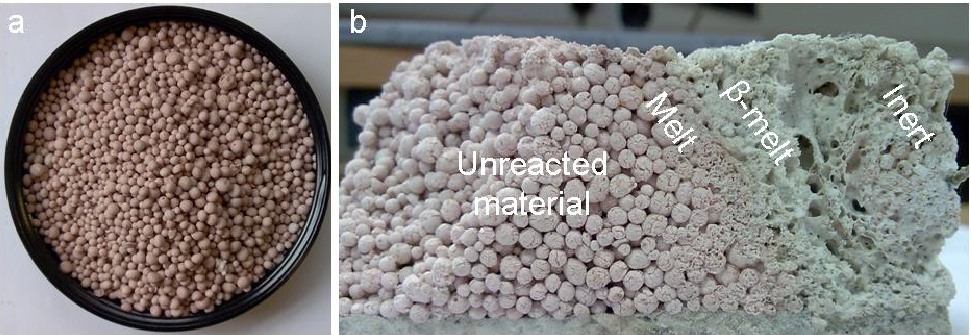
The experiments showed beyond doubt that NPK 16.16.16 can undergo a self-sustaining decomposition reaction. This results in temperatures up to 350°C and releases heat at a rate of 1.8 MJ/kg of reacting fertilizer. This is in contradiction to the UN classification that the material is free from the hazard of self-sustaining decomposition. The paper allows us to understand and quantify some of the observations during the accidental event aboard the Ostedijk.


Figure: (a) Unreacted fertilizer granules and (b) cross section showing partially reacted sample with 4 phases visible.

These experiments are important as there is very little research in the open literature regarding decomposition of ammonium nitrate containing fertilizers and this is the first time such measurements have been applied to a real scenario. They also provide an insight into this complex risk and the controlling mechanisms. The data and experimental methods can be used to further investigations into other incidents which may help in identifying causes of, and reduce losses from, this phenomenon.

Wednesday, December 08, 2010

FireGrid: An e-infrastructure for next-generation emergency response support

by Dr Sung-Han Koo

A recent journal paper titled "FireGrid: An e-infrastructure for next-generation emergency response support" has been published in the Journal of Parallel and Distributed Computing. Its content is presented here.

The costs of fire are great, commonly estimated in the range of 1-2% of GDP. Despite this, emergency service intervention at fires is often reliant upon very basic information (i.e. fire alarm panel information) or simple “gut instinct” of experienced fire officers. This need not be the case in the modern era, when a range of technologies are available which, if effectively harnessed, could transform the way in which fire emergencies are tackled, thereby significantly impacting the costs associated with failures. Here we describe development and demonstration of a novel concept which integrates sensor technologies, fire simulation, High Performance Computing (HPC) and knowledge-based reasoning, to provide an “intelligent” emergency response system known as FireGrid.

The heart of the system is the sensor-linked fire model (described in more detail in reference 17). While fire simulation has found wide application historically for design purposes, the uncertainties of fire development defeat any attempt to provide a true predictive capability of hazard evolution, generally precluding real-time use. We bypass these uncertainties by continually updating our model with a flow of sensor-derived information regarding conditions in the building. The modelling strategy exploits Monte-Carlo techniques in combination with Bayesian inference for “steering”; being “embarrassingly parallel” in nature it is ideal for implementation on multiprocessor HPC systems. The output contains embedded probabilistic information about the likelihoods of various future hazard conditions, encompassing both threat to humans (i.e. escaping occupants, and incoming fire and rescue personnel) and to the building itself (in terms of structural weaknesses, or collapse potential). The interpreted information is conveyed rapidly to the end user, i.e. the “incident commander”, to provide decision support information that can effectively assist their intervention strategies.


Initial application of a system such as FireGrid would be most relevant to high-risk and critical infrastructures, including tall buildings. It is readily apparent that better information to incident commanders could be vital in avoiding scenarios comparable to the World Trade Center tragedies, where emergency responders continued intervention operations totally oblivious to the impending
collapse of the towers. FireGrid is an ambitious vision, and its success also depends upon an effective partnership and engagement with potential end users. Our initial project was undertaken in conjunction with various members of the UK fire and rescue services, culminating in a live fullscale demonstration test attended by a broad audience including a senior fire officer. The complex evolution of the fire, with unexpected behaviours and ultimate transition to “flashover”, was an ideal test of the sensor-linked model running on the grid, and the system capabilities were effectively demonstrated. Further development of such systems extends a genuine hope that some of the chronic and long-standing problems associated with accidental fires might be eventually be overcome, with wide–ranging benefits to all relevant stakeholders.


Editor note: A related paper is discussed in "Towards the forecast of fire dynamics to assist the emergency response"

Monday, October 18, 2010

A novel methodology for simulating tunnel fires

A recent journal paper titled "A Novel Multiscale Methodology for Simulating Tunnel Ventilation Flows During Fires" has recently been published in the journal Fire Technology. Its content is presented here. This is a joint research effort between Politecnico di Torino and University of Edinburgh.

PD NOTE: This paper won this year’s Lloyd’s Science of Risk Prize in the Technology Category. The prize is awarded to academics and aims to keep the world’s leading specialist insurance market abreast of the latest academic knowledge and cutting-edge thinking. See press release by Springer.


In the past decade over four hundred people worldwide have died as a result of fires in road, rail and metro tunnels. In Europe alone, fires in tunnels have destroyed over a hundred vehicles, brought vital parts of the road network to a standstill - in some instances for years - and have cost the European economy billions of euros. Disasters like the Mont Blanc tunnel fire (1999) and the three Channel Tunnel fires (2008, 2006 and 1996) show that fire poses a serious threat.

Comprehensive risk assessments for tunnel fires are not easy to conduct. The development of the possible emergency scenarios is dependent on the combined influence of fire detection technologies, ventilation system, tunnel layout, atmospheric conditions at the portals and the presence of vehicles. Nowadays, the analysis of such complex phenomena is performed using numerical computational fluid-dynamics (CFD) tools. But CFD has a significant drawback: its requires very large computational resources (e.g., weeks or months of computing time). This limitation affects the completeness of the risk analyses because they can only be based on a limited number of possible scenarios but do not explore the wide range of possible events.

This recent paper proposes a novel multiscale modelling approach generated by coupling a three dimensional CFD model with a simple one-dimensional model. This allows for a more rational use of the computational resources. The methodology has been applied to a modern tunnel of 7 m diameter section and 1.2 km in length (similar layout to the Dartford Tunnels in London). Different ventilation scenarios are investigated involving fire sizes ranging from 10MW to 100MW.

The multiscale model is proved to be as accurate as the traditional time consuming CFD techniques but provides a reduction of two orders of magnitude in the computational time. This greatly widens the number of scenarios that can be efficiently explored. The much lower computational cost is of great engineering value, especially when conducting comprehensive risk analyses, parametric, sensitivity and redundancy studies, required in the design or assessment of ventilation and fire safety systems.

The multiscale methodology is the latest contribution to the state-of-the-art in computational methods for tunnel flow simulations. The model has been validated against experimental data of cold flow ventilation and shown to be accurate. This work was published in Building and Environment in 2009. It has also been used to provide the tunnel operator with a comprehensive assessment of the ventilation in the Dartford Tunnels, located under the River Thames about 15 miles east of London. This work was published in Tunnelling and Underground Space Technology in 2010 (open access version).