
The blog of the SFPE remind us that 10 January 2011 is the application deadline for the International Master of Science in Fire Safety Engineering Program (IMFSE).
The IMFSE is commonly organized by the universities of Ghent (Belgium - coordinator), Edinburgh (UK) and Lund (Sweden). This two-year educational program in the Erasmus Mundus framework provides the required knowledge for a professional fire safety engineer in a Performance Based Design environment.
The application forms, basic requirements and all other information are found on the website: http://www.imfse.ugent.be.
Tuesday, October 26, 2010
Monday, October 18, 2010
A novel methodology for simulating tunnel fires
A recent journal paper titled "A Novel Multiscale Methodology for Simulating Tunnel Ventilation Flows During Fires" has recently been published in the journal Fire Technology. Its content is presented here. This is a joint research effort between Politecnico di Torino and University of Edinburgh.
PD NOTE: This paper won this year’s Lloyd’s Science of Risk Prize in the Technology Category. The prize is awarded to academics and aims to keep the world’s leading specialist insurance market abreast of the latest academic knowledge and cutting-edge thinking. See press release by Springer.
 In the past decade over four hundred people worldwide have died as a result of fires in road, rail and metro tunnels. In Europe alone, fires in tunnels have destroyed over a hundred vehicles, brought vital parts of the road network to a standstill - in some instances for years - and have cost the European economy billions of euros. Disasters like the Mont Blanc tunnel fire (1999) and the three Channel Tunnel fires (2008, 2006 and 1996) show that fire poses a serious threat.
Comprehensive risk assessments for tunnel fires are not easy to conduct. The development of the possible emergency scenarios is dependent on the combined influence of fire detection technologies, ventilation system, tunnel layout, atmospheric conditions at the portals and the presence of vehicles. Nowadays, the analysis of such complex phenomena is performed using numerical computational fluid-dynamics (CFD) tools. But CFD has a significant drawback: its requires very large computational resources (e.g., weeks or months of computing time). This limitation affects the completeness of the risk analyses because they can only be based on a limited number of possible scenarios but do not explore the wide range of possible events.
This recent paper proposes a novel multiscale modelling approach generated by coupling a three dimensional CFD model with a simple one-dimensional model. This allows for a more rational use of the computational resources. The methodology has been applied to a modern tunnel of 7 m diameter section and 1.2 km in length (similar layout to the Dartford Tunnels in London). Different ventilation scenarios are investigated involving fire sizes ranging from 10MW to 100MW.
The multiscale model is proved to be as accurate as the traditional time consuming CFD techniques but provides a reduction of two orders of magnitude in the computational time. This greatly widens the number of scenarios that can be efficiently explored. The much lower computational cost is of great engineering value, especially when conducting comprehensive risk analyses, parametric, sensitivity and redundancy studies, required in the design or assessment of ventilation and fire safety systems.
The multiscale methodology is the latest contribution to the state-of-the-art in computational methods for tunnel flow simulations. The model has been validated against experimental data of cold flow ventilation and shown to be accurate. This work was published in Building and Environment in 2009. It has also been used to provide the tunnel operator with a comprehensive assessment of the ventilation in the Dartford Tunnels, located under the River Thames about 15 miles east of London. This work was published in Tunnelling and Underground Space Technology in 2010 (open access version).
PD NOTE: This paper won this year’s Lloyd’s Science of Risk Prize in the Technology Category. The prize is awarded to academics and aims to keep the world’s leading specialist insurance market abreast of the latest academic knowledge and cutting-edge thinking. See press release by Springer.
 In the past decade over four hundred people worldwide have died as a result of fires in road, rail and metro tunnels. In Europe alone, fires in tunnels have destroyed over a hundred vehicles, brought vital parts of the road network to a standstill - in some instances for years - and have cost the European economy billions of euros. Disasters like the Mont Blanc tunnel fire (1999) and the three Channel Tunnel fires (2008, 2006 and 1996) show that fire poses a serious threat.
 Comprehensive risk assessments for tunnel fires are not easy to conduct. The development of the possible emergency scenarios is dependent on the combined influence of fire detection technologies, ventilation system, tunnel layout, atmospheric conditions at the portals and the presence of vehicles. Nowadays, the analysis of such complex phenomena is performed using numerical computational fluid-dynamics (CFD) tools. But CFD has a significant drawback: its requires very large computational resources (e.g., weeks or months of computing time). This limitation affects the completeness of the risk analyses because they can only be based on a limited number of possible scenarios but do not explore the wide range of possible events.
This recent paper proposes a novel multiscale modelling approach generated by coupling a three dimensional CFD model with a simple one-dimensional model. This allows for a more rational use of the computational resources. The methodology has been applied to a modern tunnel of 7 m diameter section and 1.2 km in length (similar layout to the Dartford Tunnels in London). Different ventilation scenarios are investigated involving fire sizes ranging from 10MW to 100MW.
The multiscale model is proved to be as accurate as the traditional time consuming CFD techniques but provides a reduction of two orders of magnitude in the computational time. This greatly widens the number of scenarios that can be efficiently explored. The much lower computational cost is of great engineering value, especially when conducting comprehensive risk analyses, parametric, sensitivity and redundancy studies, required in the design or assessment of ventilation and fire safety systems.
The multiscale methodology is the latest contribution to the state-of-the-art in computational methods for tunnel flow simulations. The model has been validated against experimental data of cold flow ventilation and shown to be accurate. This work was published in Building and Environment in 2009. It has also been used to provide the tunnel operator with a comprehensive assessment of the ventilation in the Dartford Tunnels, located under the River Thames about 15 miles east of London. This work was published in Tunnelling and Underground Space Technology in 2010 (open access version).

Thursday, October 14, 2010
Heron Tower and the begining of the concept of travelling fires in design
A recent article about Arup's fire design of Heron Tower (among the tallest buildings in London) appeared in Info4fire.com. The Heron Tower project won the Fire Safety Engineering design category at the Fire Excellence Awards in May 2009.
Heron Tower is a landmark in our collaboration with Arup since it led to a joint PhD thesis and a series of papers. Since 2007 we are working together to define novel design fires in similar large spaces to that in Heron Tower. We came up with the concept of "travelling fires". The initial work was presented at Interflam 2007.

Figure: Snapshot from the fire model using FDS published here. Temperature map for a 500 kW/m2 well-distributed fire on the bottom floor with top and bottom floor ventilation. The atrium acts as a chimney, linking the bottom and the top floors.
Since then, the research has advanced significantly and led to several other papers and case studies. We recently published an overview and a building survey in the magazine Fire Risk Management. The key element behind this research is the need to provide design solutions to the large parts of modern buildings that fall outside the limits set out in the Eurocodes.
The two articles published in Fire Risk Management led to an unusual number of Letters to the Editor. Letters from Mike Wood, Pilkington Group, and from Dr Kirby, Sirius Fire Safety Consultants, were received. This and this were our respective replies (our reply to Dr Kirby is also attached below).
NOTE: Thanks to Chris for mentioning the article.
---
On Fire Risk Management Feb 2010, Dr Kirby from Sirius Fire Safety Consultants commented on our article "Out of Range".
Our reply, Beyond Limits, in Fire Risk Management March 2010 read:
We are pleased to read the letter that Dr Kirby, from Sirius Fire Safety Consultants, wrote in response to our December cover article, "Out of range". In our article, we reported a survey of 3,080 compartments on the campus of the University of Edinburgh buildings underlining the compartment volume that falls inside of the design fire specifications of current Eurocode 1 (66 % of the older buildings, but only 8% of the most modern one). Instead of volume, Dr Kirby prefers to quote our results as % of the number of compartments (95 % of the older buildings, but only 63% of the most modern one), assuming perhaps that all compartments are equally important regardless of the very large differences in size (e.g., atria vs. single desk office). But the main conclusion of our article, that the modern building contains a very large portion of built environment outside the limits of the Eurocode, stands true no matter what survey quantity is quoted.
Dr Kirby also refers to the UK National Application Document which extends beyond the Eurocode 1 range and without limit, the use of these post-flashover design fires. We consulted this document while investigating the technical origins of the Eurocode, but after two years of searching and requests, we have not been able to find a copy of the validation work it cites. If Dr Kirby or any reader of the FRM magazine could kindly send us a copy of the validation work, we would be grateful. We hope that full details of these studies are made available to the fire research community at large for the benefit of all.
We agree that Eurocode 1 is a good document and a first step putting fire engineering into a codified form. We appreciate Dr Kirby's kind words of support for research in alternative design fires. His comments on fuel-control fires in large compartments resonate very well with our previous article in this publication ("Travel guide", November 2009, pp.12-16 by J Stern-Gottfried, G Rein and J Torero). In that article, we highlight that in large compartments, a post flashover fire is not likely to occur, but that a travelling fire spreading across the floor plate should be considered instead. We think that in the future travelling fires should also be considered as design fires and compliment the current Eurocode. Work conducted to date is available and easily accessible to the fire research community at large for the benefit of all.
Dr Guillermo Rein, BRE Centre for Fire Safety Engineering, The University of Edinburgh
14 September 2009, Info4fire.com
Heron Tower is a landmark in our collaboration with Arup since it led to a joint PhD thesis and a series of papers. Since 2007 we are working together to define novel design fires in similar large spaces to that in Heron Tower. We came up with the concept of "travelling fires". The initial work was presented at Interflam 2007.

Figure: Snapshot from the fire model using FDS published here. Temperature map for a 500 kW/m2 well-distributed fire on the bottom floor with top and bottom floor ventilation. The atrium acts as a chimney, linking the bottom and the top floors.
Since then, the research has advanced significantly and led to several other papers and case studies. We recently published an overview and a building survey in the magazine Fire Risk Management. The key element behind this research is the need to provide design solutions to the large parts of modern buildings that fall outside the limits set out in the Eurocodes.
The two articles published in Fire Risk Management led to an unusual number of Letters to the Editor. Letters from Mike Wood, Pilkington Group, and from Dr Kirby, Sirius Fire Safety Consultants, were received. This and this were our respective replies (our reply to Dr Kirby is also attached below).
NOTE: Thanks to Chris for mentioning the article.
---
On Fire Risk Management Feb 2010, Dr Kirby from Sirius Fire Safety Consultants commented on our article "Out of Range".
Our reply, Beyond Limits, in Fire Risk Management March 2010 read:
We are pleased to read the letter that Dr Kirby, from Sirius Fire Safety Consultants, wrote in response to our December cover article, "Out of range". In our article, we reported a survey of 3,080 compartments on the campus of the University of Edinburgh buildings underlining the compartment volume that falls inside of the design fire specifications of current Eurocode 1 (66 % of the older buildings, but only 8% of the most modern one). Instead of volume, Dr Kirby prefers to quote our results as % of the number of compartments (95 % of the older buildings, but only 63% of the most modern one), assuming perhaps that all compartments are equally important regardless of the very large differences in size (e.g., atria vs. single desk office). But the main conclusion of our article, that the modern building contains a very large portion of built environment outside the limits of the Eurocode, stands true no matter what survey quantity is quoted.
Dr Kirby also refers to the UK National Application Document which extends beyond the Eurocode 1 range and without limit, the use of these post-flashover design fires. We consulted this document while investigating the technical origins of the Eurocode, but after two years of searching and requests, we have not been able to find a copy of the validation work it cites. If Dr Kirby or any reader of the FRM magazine could kindly send us a copy of the validation work, we would be grateful. We hope that full details of these studies are made available to the fire research community at large for the benefit of all.
We agree that Eurocode 1 is a good document and a first step putting fire engineering into a codified form. We appreciate Dr Kirby's kind words of support for research in alternative design fires. His comments on fuel-control fires in large compartments resonate very well with our previous article in this publication ("Travel guide", November 2009, pp.12-16 by J Stern-Gottfried, G Rein and J Torero). In that article, we highlight that in large compartments, a post flashover fire is not likely to occur, but that a travelling fire spreading across the floor plate should be considered instead. We think that in the future travelling fires should also be considered as design fires and compliment the current Eurocode. Work conducted to date is available and easily accessible to the fire research community at large for the benefit of all.
Dr Guillermo Rein, BRE Centre for Fire Safety Engineering, The University of Edinburgh
Tuesday, September 28, 2010
Flashover Training
 And yet again the Lothian & Borders Fire & Rescue Service has played host to a couple of University of Edinburgh ‘boffins’. This time however, they would be crawling into a steel shipping container to watch an indoor bonfire…
I somehow managed to video the event, however some parts I couldn't film properly without my camera melting.
For example, at one point you hear the instructor shouting “close the vent!” at which point the chimney above us shuts and flames shoot overhead, just about cooking me and my camera. I hit the deck and accidentally hit the zoom button. When I recover there is a firefighter ready to “knock back” the fire with a hose. Good thing someone knew what they were doing!
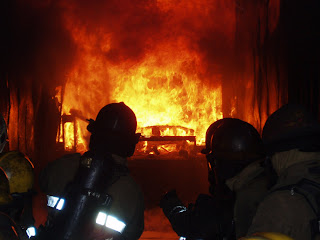
Shortly after I ditched the camera out the back of the unit and shuffled forward towards the flames. When I got there the instructor called me forward and handed me the hose. “Close the vent!” (Flames immediately start shooting overhead) “Wait...” he says. “Let it get going…Now!”
I started spraying water around. Too much. The atmosphere immediately filled with steam, the temperature increased, the smoke layer dropped and the pressurise in the compartment squeezed my head. Oops. Guess I should've listened to the briefing a bit more carefully. ‘Use as little water as possible’…Got it.
I was lucky I got to shuffle to the back again and ‘cool’ off. The temperature inside the compartment was about 750C at head height and a mere 250C down where we were crouching. I don't know how else to say this, but it was hot. (I mean, just imagine sitting inside an oven on full heat, while wearing a ski-suit).

The day was meant as a trial run for November, where I plan to
organise a repeat of the demonstration/experience with a larger group from UoE. Whether this goes ahead or not will depend largely on whether LBFRS will be willing to commit any more of their time and resources. Although from what I gather they are more than happy to demonstrate their knowledge of compartment fire dynamics!
I believe these days have been very effective in strengthening the links between academia and firefighters, and in breaking (and confirming :) stereotypes from both sides. Many thanks again to Kenny, John and Des from the SIFTC. Cheers guys.
Watch the full video on YouTube.
Mike.
Tuesday, September 21, 2010
The 2010 Ove Arup Foundation Lecture

The BRE Centre for Fire Safety Engineering at the University of Edinburgh announced the 2010 Ove Arup Foundation Lecture given by Emeritus Professor of Philosophy Peter Jones in the Playfair Library Hall,University of Edinburgh, on 6th September 2010.
Why are three heads better than one?
Or: How to prepare for a new Enlightenment
Professor Emeritus Peter Jones, FRSE, FRSA, FSA Scot
In his lecture, entitled “Why are three heads better than one? Or: How to prepare for a new Enlightenment,” Professor Jones linked historical, social and philosophical issues relevant to education, innovation and multi-disciplinarily to raise questions about the necessary route towards knowledge and the very foundations of society itself. By discussing the early life and development of Ove Arup which led him to create what has become one of the worlds most successful and imaginative engineering consultancies, Professor Jones argued that the anchors of society are to be found in the conditions for understanding; that the cement of society is conversation, and that when we ignore or lose our capacities for conversation we are in peril.
Peter Jones is Emeritus Professor of Philosophy and former Director of the Institute for Advanced Studies in the Humanities at the University of Edinburgh
The Ove Arup Foundation, which currently sponsors world leading research in Fire Safety Engineering at the University of Edinburgh

‘Why are three heads better than one? Or: How to prepare for a new Enlightenment’
Let me tell you immediately where I am going. The rampant individualism, which pervades modern western society, associated too often with obscene materialistic greed, has blinded many people to the necessary route towards knowledge, on the one hand, and about the very foundations of civil society itself, on the other. I shall argue that the anchors of society itself are to be found in the conditions for understanding: I hold that the cement of society is conversation and that when we ignore or lose our capacities for conversation we are in peril.
To create a context for such a claim, let me begin by describing some events in France in the late 17th and early 18th century, which were developed, albeit in different ways, in both England, and here in Scotland.
My interest centres on a small group of aristocratic women, who for a period of about 80 years up to the 1770s, ran private discussion groups for the leading thinkers of the day – mainly, but not exclusively in Paris. From the beginning, they explicitly set out to displace an adversarial tradition of discourse inherited from antiquity, and more recently nurtured to great effect by the Jesuits – for whom combat and victory in argument was always the goal. Nevertheless, from the 1750s onwards these ladies and their friends unexpectedly encountered a new phenomenon among the wider public. The problem was this: what seemed to work within small and self-consciously governed groups, failed to make any impact on the very much larger scale of society at large. Why was this? Did commercial competition weaken social bonds?
Membership of these salons was grounded in an implicit notion of friendship – Cicero was their source for many of their ideas – and that notion tied together a group of moral values that needed to be explained and defended whenever hostile criticism was launched on political or social grounds: osmosis could not be relied upon to ensure recognition and understanding of values - an insight, incidentally, too often ignored throughout the education profession. The moral values included mutual respect, trust, and toleration towards others, together with moderation and decorum in one’s own behaviour. But none of this was familiar to the impoverished, inflamed and unrepresented crowds that increasingly thronged to urban centres. And that is not surprising, since Cicero and his later admirers such as Hume had clearly shown how carefully the appropriate understandings had to be inculcated, learned, practised and nurtured: thought and speech are the bonds between people, and only by those means can society be understood and defended.
Because of their aristocratic position, the salonnières were relatively safe from censorship or control by those in power: but neither they, nor those holding power did anything to introduce a wider public to the requirements of the emerging civil society. Only by the 1750s were some leading French intellectuals beginning to do this, following British writers such as Locke, Addison and Hume. And like Adam Smith at the same date, they argued that the traditions of combat must no longer define the practices of thought or society itself: the mathematical obsession with the binary system of either-true-or-false may be defensible for abstract ideas and immaterial matter, but for living things and any contexts where dynamic change and multi-caused variations occurred, it was wholly inadequate.
I should emphasise that the conversations in Paris, like those in contemporary English and Scottish Clubs, addressed urgent practical issues at least as often as purely speculative problems. The French also adopted the British view – most clearly set out by Hume – that knowledge is a social phenomenon, and, most significantly, cannot be acquired alone. All our claims to factual knowledge must first be publicly expressed and understood, and then confirmed or rejected by others. Such claims have two further features. They are only ever provisional, having none of the certainty of mathematics: secondly, they are embedded into what is already accepted, however untenable that may later be judged to be. Such was the context in which a new generation of non-theological encyclopaedias appeared from 1700 onwards. These were soon expanded into multi-authored teamefforts, devised to communicate the latest understanding of practical matters, alongside elucidation
of current theological, scientific and economic ideas. The greatest of them all, the great French Encyclopédie began to appear in 1751, but provoked frequent censorship, and the final volumes of text and illustrations took another 30 years. The availability in print of such a vast range of information and viewpoints inevitably provided opportunities for new approaches in established disciplines and professions.
But that is not what happened.
The main reasons were that the existing professions were firmly anchored in their traditions of thought and practice. Lawyers were fiercely resistant to insights from the social, political or philosophical realm; theologians obsessed with defending traditions and their power bases. The emerging profession of architecture, separating itself from its ancient integration with engineering and building practices, and wallowing in the new commercial opportunities of the 18th century, soon lost touch with reality: Robert Adam not only bankrupted his family firm but two thirds of his clients. Only medicine and engineering, to a significant degree, seemed alert to the technological and social changes in society. Engineering had long been in receipt of Royal or Government patronage because it was central to all defence budgets. Medicine, too, aided by rapidly developing technologies and the replacement of theoretical dogma by experiment, broadened its acknowledgment that multiple-causation might be at work, and that diverse approaches might yield fruitful results. John Pringle, who vacated his chair of Philosophy here to return to medicine, was already enquiring about his patients’ life-styles, eating, work and sleep habits, family history, housing by the late 1740s. He was one of Hume’s doctors.
Nevertheless, the twin influence of ever more advanced mathematics, on the one hand, and the inherited Aristotelian and Boylean model of atomic analysis on the other – that is, the reduction of the target problem into its supposed atomic and further unanalysable constituents – such influences effectively erected barriers around each discipline, which then became both more specialised, and less open to contact with, or influence by, researchers in even neighbouring fields. Professions increasingly sought status and influence, and jealously guarded their domains. What most professions overlooked, however, was the other half of Aristotle’s explicit methodology – he was trained as a doctor, let us not forget: the study of a thing’s various relations with other things, and the processes by means of which it inter-acted with them. As I have already said, leading figures in the 18th century prepared the ground for us today precisely by stressing such factors, and thus the occurrence of multiple causation, reciprocal re-action, and constant change – which themselves explained our frequent inability to anticipate consequences. Of course, traditionalists still yearned for a universal viewpoint which transcended all particular viewpoints, but they were generally disregarded, albeit often not in politics which, then as now, was religion by another name.
It is still not fully acknowledged that multi-disciplinary enquiry and co-operation are the only ways to ensure that we adopt multiple viewpoints, examine multiple causes and variables, and overcome obstacles generated by obsolete concepts, assumptions, practices and technologies. And multidisciplinarity needs to be overtly grounded in historical knowledge about the concepts and technologies inherited from the past – scientists in general have been naively dismissive of histories of their disciplines, and have thereby been wilfully blind to opportunities it yields. We must be alert to the histories of our ideas and practices, because modified concepts always retain elements and scars of their abandoned predecessors. Moreover, when we complacently concede that our claims hold only so long as ‘other things remain equal’ we usually forget that we never know all the assumptions and implications of what we have said or done.
Let me give you just one example of a state of affairs which, because the ‘ceteris paribus’ clause was initially forgotten, resisted analysis: land-degradation in arid and semi-arid areas, known as ‘desertification’. No one knows whether, or to what extent, climatic change has increased desertification, whether adverse land use has a feedback effect on local climate, or how global changes are influenced by dryland degradation. The compound set of causes in play probably includes sub-sets of the following factors in differing proportions: global climatic trends, world trade conditions and local government agricultural, technical, marketing, and financial policies; health, population growth and distribution; land shortage and usage; soil and vegetation, appropriate technologies, education and research – the interaction of such factors, and surely many more, affect productivity, erosion and vegetative cover.
Cicero and his followers insisted that to talk of proprieties in any context - that is, to judge what it is proper to do - is to make a value judgment. It is essential to learn how value judgments are made, by whom, when, and why. How a concept is understood and used, and thus what it means to someone, is intimately tied to how, when, where and from whom that individual learned to use the concept. The indefinite variety of contexts in which an individual can become acquainted, familiar and comfortable about using a concept lies behind the range of misunderstandings that occur and the often heated disputes about the authority, consequences and very meaning of a concept. Multidisciplinary enquiries have to address these matters at the outset of their work together.
So where does my emphasis upon conversation come in? Before you withdraw all patience, on the grounds that quite enough conversation already takes place, let me hasten to state my proposed definition:
Conversation is a sacred and improvisatory practice in which the duty to listen
precedes the right to speak.
Conversation is a practice, because it requires a range of learnable skills, which must be used or lost. It is sacred because it embodies and conveys the values of the community in which it operates. The duty to listen underlines the necessity of judging the context before being able to estimate what might be appropriate behaviour; it also emphasizes the central role of manners in conversation, in which courtesy to others takes precedence over assertion of oneself – a point on which Hume prominently insisted. The right to speak is earned, but is also circumscribed by the requirement of appropriateness. Instruction to children to wait their turn, not to interrupt or hog the conversation, just listen to what is being said - all such guidance is directed to that end, and also answers the mistaken objection that if listening precedes speaking everyone must remain silent. That, of course, is absurd. What actually happens, and indeed must happen, is that learning the arts of conversation takes place in contexts of already existing and complex human social practices: conversations typically evolve out of chat. Nevertheless, we have to be sensitive to the knowledge, attention span and interest of the listener – not to become boring, insistent, intrusive, upsetting, offensive: all matters concerning how others see us. Which was Adam Smith’s famous point in 1759 about learning to see ourselves as others see us.
Smith also said this [336:VII.iv.23]: ‘The great pleasure of conversation and society … arises from a correspondence of sentiments and opinions, from a certain harmony of minds, which like so many musical instruments coincide and keep time with one another’. The analogy between the improvisatory character of both conversation and music was commonplace by the early 1700s, because the emphasis was upon close attention and constant adaptation to a changing context – without which there can be no appropriateness. The great musicians of the 18th century were admired for their extraordinary skill at improvisation, - Bach, Handel, Mozart - and even at the popular level, no Scots fiddler at the dance, for example, ever stuck to the minimal scores available. Similarly, properly educated and engaged conversationalists improvised throughout their performance, which would be centrally coloured by their body-language as well as by vocabulary, tone, pitch and so on. All of these ideas were explicitly discussed by our forebears because the primary duty was to perform appropriately in the theatre of social life. Sensitivity to the context was thus a necessary condition. French and Scottish philosophers argued, moreover, that human beings are animated not by reasoning as such, but are motivated by, and respond primarily to, their feelings. This means that judgments of propriety are as much aesthetic judgments as verdicts about thought.
Conversation cannot take place among a large group of people: the family provides the natural scale, and almost all cultures have found that groups over twenty are too large. Renaissance writers thought that nine was the maximum number, and the French, like the Greeks, stuck at about twelve. The central reason for advocating the family scale is that everyone in a conversation is a participant – whether or not they actually speak on a given occasion. Indeed, in a proper conversation, silences are essential and have different characters – a threatening silence is very different from one of awe or suspense. A second reason is that conversations are most often practised when sharing the very essentials of life – food. Children learn and absorb much from family meals – and many cultures over the centuries have judged dining to be essential for social bonding. In the French salons it entailed self-conscious preparation by host and guest, and bequeathed a legacy which has properly enriched western culture ever since: who might appropriately sit with whom, what topics might be appropriate for conversation, with whom and when, why some issues might be best avoided or diverted.
The less formal social gatherings in London coffee shops and taverns from the 1680s, although widely publicised, were never fully replicated elsewhere. Moreover, what happened in Scotland was importantly different, because to the Scots the whole point of knowledge was use and benefit: the explicit goal of their ‘clubs’ and ‘societies’ was knowledge, to which the social side merely a means. The point needs emphasis: conversation is not only a source of the moral values we absorb and understand, it is a crucial vehicle by which we acquire knowledge – since encounter with, and mediation by the claims of others assist in the detection of error and the emendation of earlier opinion. Two heads are never enough because each is focussed on his own or the other’s view, fighting for a conclusion, rarely on transcending both views or ensuring continuous exploration: a third head can more easily release all of them from the combat ring – reminding all of the ‘ceteris paribus’ clause.
To portray conversation as the cement of society allows us build on the metaphor: by examining the cement, we can identify the scale of the structures it bonds and supports – and whether there are some structures it does not well bond or support. For the scale of everything we do affects both their quality, and their inter-connections with everything else. It was asserted for well over a century in France that the proprieties of conversation are the very same as the proprieties of society, and to study one is to study the other.
The notions of scale and propriety which are central to our discussion derive almost as much from the classical world of architecture as from moral philosophy and rhetoric. The learned Renaissance scholar and architect Leon Battista Alberti, emphasized that proportion and appearance could be assessed only by reference to the precise details of each particular case. He advised architects always to invest in the largest possible model of their intended structures, before going further, in order to help both them and their clients to judge what might be appropriate. The reason then, as now, is that what works at one scale will not necessarily work at another: a small work cannot retain all its forms and relations when enlarged – and the other way round, as well. His point is that scale is a condition of intelligibility – to stretch a concept, for example, beyond the expected parameters of use is to diminish the possibility of understanding, and thereby the capacity to act appropriately in the new context.
We too readily forget that our concepts are tools, invented by us, for particular tasks in particular contexts which are conceived in particular ways, and that their history through different contexts records unexpected distortions: they are all, at different rates, becoming outdated, unwieldy or simply obstructive in new contexts. Meanings change with contexts – witness the term ‘democracy’ as a dramatic example or, in our context, the titles of ‘engineer’, architect’ or ‘philosopher’. It follows that all our categories and practices – or tools – are obsolescent in the sense that they are condemned by their very anchorage in time to be increasingly inappropriate in ever changing contexts. Finally, there are evaluative tones colouring many of our concepts, and almost any term can assume significant emotive influence on what happens.
You will now grasp how all this bears on Ove Arup and current aspirations and proposals, although a word about his life and beliefs may also help.
A few weeks after Ove Arup was born in Newcastle, in 1895, his father, the Danish Consular Vet. was posted to Hamburg. Accordingly Ove spent his early years there, acquiring German as his first daily language – although he spoke Danish and Norwegian at home and on family holidays. After boarding at the Danish Eton, he proceeded inexorably to Copenhagen University where he spent 9 years. His first degree was in philosophy, then mathematics, and finally engineering – he was also, I might add, a pianist of almost professional standard. Ove’s interest in philosophy had been excited at school, where he devoured Kierkegaard, of course, but also Charles Darwin. At University, where he unwisely expected to become a lecturer in philosophy, he revelled not in the dominating universalist and abstract dogmas of German philosophy, which he fiercely rejected, but in the pragmatic ideas of British empiricists, beginning with Locke and Hume.
In the Denmark of 1922, the distance between ‘applied philosophy’ and engineering, which was held in the highest social esteem, was not as wide as you might think, and the historicalexplanation is illuminating. At the end of the Napoleonic Wars Denmark had declared national bankruptcy. The King and Council pursued two paths of reconstruction – both derived from Enlightenment thought. In the short-term they promoted new industries that had already proved to be prosperous: more importantly, they invested in long-term scientific education. Over a period of 20 years local mineral resources were mapped and identified [clay and chalk] and by 1850 six factories had been constructed to produce ‘roman cement’ – layman called it concrete. Within a further decade the Technical University had inaugurated both research and courses in structural engineering, in which the use of concrete for marine work was central - groynes, jetties, harbours and coastal protection for a marine nation. Above all, interaction and co-operation were explicitly fostered between civil and private sectors, and all branches of engineering – civil, mechanical, chemical and so on. Whenthe young firm of Christiani & Nielsen established itself in 1904, they specialised in re-inforced concrete design and construction – procedures which were attracting avant-garde architects in France and Germany, as well as America, in addition to everyone involved in marine work.
Following the deep recession after the First World War, politically alert young architects – and that meant liberals or socialists – turned to concrete as a material for addressing housing problems. Reinforced concrete enabled them to invent new systems of columns, walls and slabs to construct low-cost buildings with an unskilled workforce. But such steps raised questions of quality control and, once again, Christiani was ahead of the game, ensuring not only site surveillance, but research into manufacturing processes and chemical reactions.
So, employment by such a firm was an obvious route for someone like Ove to follow. Moreover, two names had already caught his attention – and both men became friends later on. Le Corbusier, whose celebration of concrete in 1922 coincided with Ove’s final graduation; and Walter Gropius, whose Bauhaus ideas about the integrations of craft and artistic skills also echoed Danish hostilities towards any approach which fostered fragmentation and disintegration of ideas.
The ideas which inspired Ove Arup to found his own firm in 1946 lay in the 19th century Danish practices which I have outlined, underpinned by his philosophical studies. These had convinced him from an early age that there were no natural or permanent boundaries between enquiries, disciplines, or professions: all such boundaries are man-made constructions, sometimes arising from convenience, always from the limitations of our knowledge, and often strengthened by prejudice or fear. The divisions we make in our enquiries, like the concepts we use, the methods we adopt, the hypotheses we pursue and the theories we temporarily employ, are merely devices to help us cope - and which in due course become barriers to further progress. Moreover, they can never encompass more than a fraction of what we might want to do and know. Disciplinary boundaries can help us to focus, but never to expand our vision: all claims made within the boundaries are provisional, and all are likely to be displaced in the future – those words are taken almost verbatim from a French writer in 1749 [Buffon].
No doubt you all learned this in the third form, but in the London of 1923 such views were simply unintelligible throughout most of the class-ridden British professions, and by 1946 were generally dismissed as needlessly subversive in a context of urgent social renewal, and severe financial constraints. Britain was the only European nation with no advanced technical polytechnics dedicated to engineering or mining specialities. And the more Ove acknowledged to himself the ignorance and bigotry among architects and engineers alike, the clearer became his goal. From the mid-1950s onwards he criticised architects for their technological ignorance, their narrow notion of design – virtually restricting it to the aesthetics of drawings, thereby substituting conception for execution – and their social irresponsibility towards clients, costs, the environment, and management.
The fundamental education, and the established practices of architects and engineers alike, had to be radically reformed. At the foundation level, engineers had to be taught draughtsmanship, design and aesthetics; architects had to be taught engineering, philosophy and self-critical communication skills. And they both had to learn to work together and with their clients, from the outset of any single commission. Ove deplored obscurantist architectural verbiage, the selfdeceiving arrogance of anyone hiding behind the mask of a romantic artist, as well as the intellectual narrowness, philistine insensitivity and social irresponsibility of engineers. In 1941 he had declared that no architect could ‘possibly, by himself, know all about all the intricacies of modern technical developments which go into a building nowadays’. What was needed was an ‘organisation, “the composite mind” so to speak, which can achieve a well balanced synthesis from the wealth of material available’. By 1970 this had become:
“The Terms Architect, Engineer and Builder are beset with associations, from a bygone
age…and they are inadequate to describe or discuss the contemporary scene.”
It is not surprising that in anti-intellectual Britain, his listeners felt distinctly uncomfortable.
Narcissistic institutions typically spend more effort on defending their structures, than pursuing their goals, and many of Ove’s challenges were social, requiring recognition of power bases and egos, political and professional agendas, personal ambitions, and confrontation with deeply embedded protestant individualism: but they were equally intellectual and psychological, requiring admission that ideas cannot be owned, and that helpful analogies can be derived from, and should be sought in unlikely places.
Ove himself deplored theories and ideologies of any kind – political, religious, artistic or scientific: they, too, can be only provisional devices, and eventually inhibit critical thinking. As a sceptical, empirical philosopher, he held that we might always be mistaken, and that the only justifiable approach is relentless self-critical enquiry. That is why, in August 1917, he proclaimed that the ultimate immoral act is choosing not to think.
In any small organisation led by a charismatic founder, most colleagues will be at least tolerant of the mind-set I have described: but the larger it gets, and the greater the diversity of its practices, the less likely is it that everyone would fully comprehend such a philosophically grounded posture. Ove worried about this within a year or two of founding the company: by 1948, with less than 10 fulltime colleagues, he declared that ‘it was too big’. This was not the response of a control-freak, keen to influence and participate in every decision. Rather it was awareness that the scale of any concept is central to its intelligibility, and to the success of any activities based on it: evolution of thought and practice is necessary for survival, in every domain, but if team members either disregard or fail to understand the guiding principles, fragmentation of effort ensues, and failure threatens. Moreover, scale defines not only the justification, but also the quality and effectiveness of all human activities.
Ove’s ideas did not evolve as much as they might have done outside Britain: he lacked critical discussion, and drifted into a rhetorical mode followed by so many writers: he simplified his conclusions about the provisional nature of all proposed solutions to the extent that they merely provoked derision from architects, planners, politicians and businessmen.
In both the story I have told, and in the tasks ahead of us CONTEXT is all. Ove’s philosophical training in a Continental tradition; his multi-lingual abilities and broad cultural interests – together with why concrete was specially developed in Denmark; and why the engineering and architectural professions stood in the relation to each other that they did. All these contributed to the outcomes associated with his firm. But CONTEXT is also a central criterion in judging the built environment: structures articulate spaces and places, planes and surfaces – in brief, they affect how we live and think. But although many engineers, architects and planners revel in the magnitude of these burdens, few educate their clients: and the breadth of CONTEXT is ignored.
But, I hear you say: ‘Are you seriously saying that in today’s best universities, among the established professions, indeed, in society at large, conversation, in your idealised definition, does not take place?
And are you really saying that that notion can guide us forward in a radical reform of education, and even reform of society itself? Are you arguing that the ego-trip enjoined by self-expression, self-promotion and self-fulfilment must be curtailed in the face of the fact that knowledge is a social phenomenon and cannot be acquired alone?’ Yes: Ove did: I am.
Where we go from here is up to all of us.
Let us not further deceive ourselves into believing that, over the centuries, Governments or Institutions or Professions have always, or even very often, put into place people and resources to promote relentless, self-critical and exploratory thinking. That is why I endorse Ove Arup’s personal credo:
The ultimate immoral act is choosing not to think.
Thursday, September 16, 2010
2009 Hinshelwood Award for Dr Rein

[Photo courtesy of Prof Jose Torero]
Dr Guillermo Rein was awarded the 2009 Hinshelwood Award at the Annual General Meeting of the Combustion Institute held at the University of Cambridge on September 15th, 2010.
The Hinshelwood award is named after Prof. Cyril Norman Hinshelwood, 1956 Nobel Laureate in Chemistry. This award is given for the “Meritorious work of a young scientist of the British section of the Combustion Institute” and, together with the Sugden prize (for best journal paper), is the most important award the Combustion Institute delivers in the United Kingdom. The award was presented by Prof. Allan Hayhurst, Chair of the British Section of the Combustion Institute.
Congratulations Guillermo!
 Guillermo Rein, together with Sugden Prize winners Prof Derek Bradley & Gautam Kalghatgi.
Dr Angus Law
 Congratulations to Angus Law, who passed his PhD viva on the 6th of September, with the examiners requiring only minor corrections to his thesis. Well done Dr Law!
Monday, August 30, 2010
2009 New Impact Factors for fire related journals
The Journal Citation Reports has released the impact factors for 2009.
The impact factor, one of the measures available to rank journals, is the frequency with which the "average article" in a journal has been cited in the previous two years. It is calculated dividing the number of citations to papers published in the previous two years by the total number of items published during the same period. In order and for fire related journals, these are:
- Progress in Energy and Combustion Science 12.440
- Journal of Hazardous Materials 4.144
- Proceedings of the Combustion Institute 3.510
- Combustion and Flame 2.923
- International Journal of Wildland Fire 1.901
- Building and Environment 1.797
- Fire Safety Journal 1.259
- Engineering Structures 1.256
- Experimental Thermal and Fluid Science 1.234
- Fire and Materials 1.196
- Combustion Science and Technology 1.142
- Journal of Structural Engineering 0.928
- Journal of Fire Science 0.860
- Fire Technology 0.366
- Journal of Fire Protection Engineering 0.296
Clarification (derived from the wikipedia):
The 2009 impact factor of a given journal is equal to A/B. Where A is the number of times articles published in 2007 and 2008 were cited during 2009, and B is the total number of papers published by that journal in 2007 and 2008.
The impact factor, one of the measures available to rank journals, is the frequency with which the "average article" in a journal has been cited in the previous two years. It is calculated dividing the number of citations to papers published in the previous two years by the total number of items published during the same period. In order and for fire related journals, these are:
- Progress in Energy and Combustion Science 12.440
- Journal of Hazardous Materials 4.144
- Proceedings of the Combustion Institute 3.510
- Combustion and Flame 2.923
- International Journal of Wildland Fire 1.901
- Building and Environment 1.797
- Fire Safety Journal 1.259
- Engineering Structures 1.256
- Experimental Thermal and Fluid Science 1.234
- Fire and Materials 1.196
- Combustion Science and Technology 1.142
- Journal of Structural Engineering 0.928
- Journal of Fire Science 0.860
- Fire Technology 0.366
- Journal of Fire Protection Engineering 0.296
Clarification (derived from the wikipedia):
The 2009 impact factor of a given journal is equal to A/B. Where A is the number of times articles published in 2007 and 2008 were cited during 2009, and B is the total number of papers published by that journal in 2007 and 2008.
Sunday, August 29, 2010
Reaction to fire by Chimpanzees vs Homo-Nighclubis
Brief comparison: Reaction to Fire by Chimpanzees vs Homo-Nighclubis (modern Homo-Sapiens @ night and under severe alcohol and/or drug intoxication) by Agustin Majdalani.
The following comparison is based on the following paper:
Reaction to Fire by Savanna Chimpanzees (Pan troglodytes verus) at Fongoli, Senegal: Conceptualization of ‘‘Fire Behavior’’ and the Case for a Chimpanzee Model, by Jill D. Pruetz and Thomas C. LaDuke, American Journal of Physical Anthropology 141 (4), pp 646–650, April 2010.
 The use and control of fire - unique human trait in the animal kingdom according to Goudsblom, (1986) - are hypothesized to correlate with an increase in intellectual complexity (ref). It is believed that humans may possess evolved psychological mechanisms dedicated to controlling fire and apparently such mastery entails some degree of self-restraint from the urge to flee from a fire. This is in contrary to the general fire avoidance behavior associated with other animals (Goudsblom, 1986).
 Nevertheless, given the difficulty in assessing archaeologically the use of fire, estimates of which hominid species exhibited such behavior first are necessarily conservative. It is currently estimated that the ability of fire control came about fairly late in the evolution of our lineage, i.e. around 2.5 million years ago according to data from Karkanas et al. (2007). By this time, the cranial capacity was already quite large in comparison to earlier homos. Earlier homos had a similar capacity to that of modern wild chimpanzees.
Given the relatively sophisticated cognitive abilities yet small brain size of modern apes compared to humans and even to early hominids (ie Australopithecus), Pruetz et al., the authors of this recent paper in American Journal of Physical Anthropology, consider that careful observations of wild chimpanzees’ reactions to wildfires can help construct hypotheses about the likely responses to fire of early hominids. Their field observations during naturally occurring wildfires lead them to the conclusion that wild chimpanzees may possess some degree of self-restraint from the urge to flee from a fire.
1) Conceptualization of fire, i.e. an understanding of fire behaviour under varying conditions that would allow one to predict and anticipate its movement, thus permitting activity in close proximity to the fire.
2) The ability to control a fire, involving containment, providing or depriving the fire of fuel, and perhaps the ability to put it out.
3) The ability to start a fire.
A table summarizing the interpretation of the observation of both groups of hominids (also known as great apes including chimpanzees, gorillas, humans, and orangutans), is pasted below. These groups are: chimpanzees and what we called Homo-Nighclubis or “nightclub” humans (i.e., regular or “daylight” humans acting in a non-evolutional emotional way due to the accidental influence of the surroundings together with some strange chemistry going on in their blood pumped into their brains).
| Chimpanzees interpretation (by Jill D. Pruetz & Thomas C. LaDuke) | "Nightclub" Humans interpretation (by Fire Safety Engineers) |
| Chimpanzees at Fongoli calmly monitor bush fires at close range and change their behavior in anticipation of the fire’s movement. | Nightclub humans excitedly monitor the disco fire at extremely close range and change their behavior in anticipation of the DJ and green laser movement. |
| We interpret the chimpanzees’ behavior as being predictive rather than responsive in that they showed no signals of stress or fear other than avoiding the fire as it approached near them. | Same here, save that instead of avoiding the fire some kind of fun behavior and willingness to touch it is evidenced in the initial stages of the incident. |
| Therefore, we maintain that they were predicting that the fire would continue its pace of burning and its movement and were unconcerned, for example, that it would suddenly leap forward and burn them. | Exactly, that was what these “nightclub” humans were (wrongly or at least too risky) thinking we guess: “it won’t suddenly spread and burn me. Even the smoke is has a nice and sweet smell”. |
| The fact that they sat directly in front of the advancing fire at a proximity that made the observer feel uncomfortable for her safety demonstrates that they were comfortable with their understanding of its behavior and their ability to predict its movements and adjust their responses to it. | No, no, no... Here we disagree: the fact that they danced clapping and jumping directly in front of the advancing fire at a proximity that make any observer of this video feel uncomfortable for their safety demonstrates that they were unaware of the danger, misunderstanding the fire behavior, and adjusting their responses just to the sound of fire, music and crowd altogether. |
| These behaviors demonstrate the cognitive ability to adjust to a potentially harmful agent. | Mmmmmm... No agreement here either regarding our Homo-Nighclubis sampling. |
| We propose that the first cognitive stage in the control of fire (i.e. Conceptualization of fire: an understanding of the behavior of fire under varying conditions that would allow one to predict its movement, thus permitting activity in close proximity to the fire) characterizes chimpanzees living today. | We propose that “nightclub” humans didn’t develop this cognitive stage, although they allow themselves activity in close proximity to the fire. In risk terms, this would be like piloting a space shuttle without even knowing what a RC model plane looks like. |
| The previous point suggests that chimps have formed a mental prediction of the fire’s movement. Variables that should be taken into account include flame height and width and fire intensity, as influenced by topographic and climatic factors. Considering such variables and predicting the behavior of fire is a complex task. | No doubt those predictions are an extremely complex task, which we think not even "daylight" humans (i.e. 100% of the human population not subject @ the moment of study to a nightclub atmosphere and its bizarre effects) are able to develop, and certainly we can assure “nightclub humans” DON´T. |
| Observations at Fongoli suggest that, like humans, chimpanzees are able to control their fear impulse in response to fire. | Same interpretation here again after observing our sampling behavior, but with the topping that they not only control their fear, but also dance altogether singing to the rhythm of "the roof, the roof is on fire!”, roaring with laughter inside a smoke cloud. |
The remaining dominant male exhibited a slow and exaggerated display ‘‘toward’’ the fire in a manner analogous to the ‘‘rain dance’’ exhibited here and elsewhere here chimpanzees have been studied. (Goodall, 1986) | Well, we’re not certain about the dominance of those males remaining in the dance club completely ignoring the alarm, but as the chimps did, they exhibited the same slow and exaggerated display ‘‘toward’’ the fire in a manner analogous to the ‘‘rain dance’’. |
It seems like humans can transform into other species in nightclubs, isn’t it…? No doubt about it, and we’re only analyzing the fire behavior, let’s not even go to the reaction to flirting!
Concluding, if we accept the idea that conceptualization of fire is prerequisite to its control and use, then identifying such conceptualization at a more basal node in the hominid phylogeny than previously hypothesized (i.e. chimps or better because of their lower evolutionary state “nightclub” humans) implies that control and use might have been possible earlier than formerly thought based on the date of first appearance in the fossil record. Thus, if the cognitive underpinnings of fire conceptualization are a primitive hominid trait, hypotheses geared to explaining the control and use of fire in certain taxa may need to be re-examined!
As a final word on the Luna Nightclub fire, we would like to say that, as no one was injured, we looked at this emergency with a little bit of a sense of humour. But nevertheless, this combination of nightclub (usually overcrowded) + fireworks + alcohol have proved to be one of the most lethal combinations leading to high death tolls. Some examples of this are (Source is NFPA files on major fire incidents):
Iroquois Theater, Chicago, IL, 1903. Deaths: 602
Disco/dance hall, Gothenburg, Sweden, 1998. Deaths: 63
Disco/dance hall, Luoyang, China, 2000. Deaths: 309
The Station nightclub, W. Warwick, RI, 2003. Deaths: 100
Republica Cromagnon, Buenos Aires, Argentina, 2004, Deaths: 194
So, the message –in this case without sense of humour- goes to society as a whole: we must take care of ourselves, and this situation it means that those “nightclub humans” should be protected by the hole “system” (codes, enforcement, fire safety engineers, owner of nightclubs, etc…) as we cannot expect them to have a nice and organized evacuation in case of emergency. It is the society’s responsibility to protect this people (ourselves!) to be subject to a dangerous similar situation as the one recorded in this movie.
by Agustin Majdalani, BRE Centre for Fire Safety Engineering, University of Edinburgh.
Tuesday, August 24, 2010
The Rasbash Lecture 2010: Fire and Structures


The Institution of Fire Engineers
and
The University of Edinburgh
The Rasbash Lecture 2010
Swann Lecture Theatre
The King’s Buildings campus
14.00 hrs Tuesday 7th September 2010
Structural Fire Engineering Past, Present & Future
by
by
Professor Roger Plank BSc PhD CEng MICE FIStructE, University of Sheffield
Event free of charge, just RSPV with Sarah Simpson
ABSTRACT
This paper reviews these developments, discusses the principal outstanding issues and speculates on future directions.
Professor Roger Plank BSc PhD CEng MICE FIStructE, University of Sheffield
Roger studied Civil Engineering at the His honours include the Institution of Structural Engineer's Henry Adams Award (1997), and the ASCE's Raymond C Reese Research Award (2005). His research in structural fire engineering has also led to the development of the award-winning design software, Vulcan which is being increasingly used in practice. He has held several positions as Visiting Professor and specialist consultant, and has chaired a number of committees for the
Although he retired in November 2009, he remains active in both research and consultancy. He is currently lead member of an expert panel advising the DCLG on fire research, chairman of the Steel in Fire Forum, a member of the Steel Advisory Group which provides direction for the EU's Research Fund for Coal and Steel, and an evaluator for the European Research Council.
He is currently Senior Vice President of the Institution of Structural Engineers.
Subscribe to:
Posts (Atom)